BENEFITS 益处
Improve Spinal Mobility: Significantly enhance spinal articulation through controlled flexion and extension. Strengthen Shoulder Girdle Stability: Train the dynamic organization of the scapulae on the rib cage in hanging and supporting positions. Whole-body Integration and Stretch: Combine hip dissociation with axial elongation to improve tension in the anterior chain and strength in the posterior chain. Improve posture.
提高脊柱灵活性: 通过受控的屈曲与伸展,极大地增强脊柱的分节活动能力。强化肩带稳定性: 在悬挂和支撑状态下,训练肩胛骨在胸廓上的动态组织模式。全身整合与伸展: 结合髋部分离与中轴延伸,改善身体前侧链的张力和后侧肌群的力量。改善姿态。
TARGET MUSCLES 目标肌群
Spinal Extensors: Erector spinae, multifidus (activated during the back extension phase). Shoulder Girdle Stabilizers: Serratus anterior, lower trapezius (maintaining scapular alignment while hanging). Core Muscles: Internal/external obliques, transversus abdominis (controlling axial length during the hanging and curling phases). Lower Limb Muscles: Gluteus maximus, hamstrings (stabilizing foot alignment on the ladder rungs).
脊柱伸展肌群: 竖脊肌、多裂肌(在后弯阶段激活)。肩带稳定肌: 前锯肌、下斜方肌(维持悬挂时的肩胛对位)。核心肌群: 腹内/外斜肌、腹横肌(在身体后垂及卷动阶段控制中轴长度)。下肢肌群: 臀大肌、腘绳肌(稳定足部在梯级上的对位)。
SETUP 设置
Remove sliding bar and springs.
移除滑动杆和弹簧。
CUES 口令
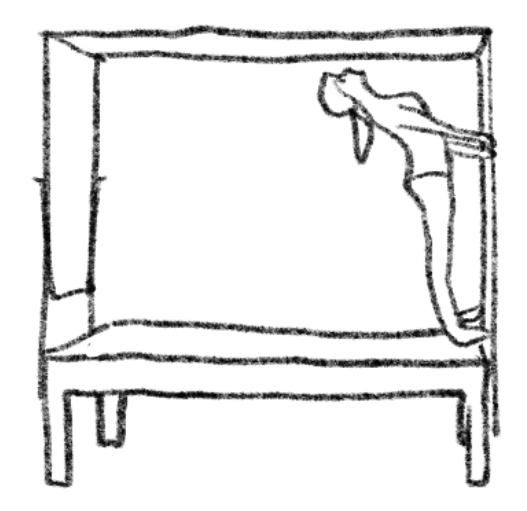
【Starting Position】Stand on the table facing the upright poles, grip the poles, and place the balls of the feet against the uprights. Bend the elbows, gripping the poles at lower sternum height. 【Breathing】Inhale: Elongate the spine and feel yourself standing taller. Exhale: Slowly straighten the arms and allow the body to hang back, forming an elongated C-curve from head to toe. Inhale: Push through the feet, roll the torso to vertical, lift the sternum, bend the elbows, and roll into thoracic extension (backbend), keeping the collarbones wide and gaze toward the ceiling. Exhale: Return to the upright starting position. Repeat the flow from full flexion to extension 3 times with smooth transitions. 【Variations】A wide footboard, mat, or shoes can be used under the balls of the feet. Can be practiced standing on the floor. For clients with osteoporosis, maintain a neutral spine instead of performing spinal articulation.
【起始位】站在床上,面向塔杆站立,手抓立柱,脚球抵住直立杆。 手肘弯曲,手抓直立杆的位置在胸骨下端的高度。【呼吸】吸气,脊椎延伸,感觉站的更高。吐气,手臂慢慢伸直,让身体往后垂挂,从偷到脚变成延长的C字形。吸气,脚推杆,让躯干卷动到垂直,胸骨往上,手肘弯曲,胸椎卷动伸展后仰,保持锁骨展开,眼睛看向天花板。吐气,回到身体直立,开始的位置。重复持续练习,让身体由完全前弯屈曲到伸展后仰的姿势3次,动作要流畅。【变化】可以脚球下加上宽脚踏板、踏垫或穿鞋。可站在地板上练习。有骨质疏松的客户,可以不做脊椎分节动作,而是保持脊椎中立位练习。
IMAGERY 意象
【Direct】As you exhale and hang back, feel the physical distance between the pubic bone and the sternum infinitely lengthening, creating transparent gaps between each vertebra. 【Indirect】Imagine your body as a giant, opening compass; the uprights are the pivot points, and your torso is the drafting arm gliding smoothly through space. 【Spatial】As you enter the backbend, try to fill all the void between the bars and the table with your energy, allowing the body to occupy the maximum vertical span in three-dimensional space. 【Sensation】Feel the spinal articulation like slowly peeling a soft plastic film off warm glass, the movement carrying a texture of delicate, visceral, and precise control.
【直接】呼气向后垂下时,感受耻骨与胸骨之间的物理距离被无限拉长,在每一节椎体间创造出透明的间隙。【间接】想象你的身体是一个巨大的、正在开启的圆规,双侧梯级是支点,你的躯干则是正在空间中平滑滑动的绘图臂。【空间】在进入后弯时,尝试用你的能量去填满横杆与床台之间所有的虚空区域,使身体在三维空间中占据最大的垂直跨度。【感觉】感受脊柱的分节如同缓缓揭开一张紧贴在温热玻璃上的软塑胶膜,动作带着一种细腻、粘稠且精准组织控制质感。
TACTILE CUES 触觉提示
Touch thoracic spine to guide extension; remind to press heels down.
触碰胸椎引导伸展;提醒脚跟下压。
PROGRESSION 进阶
Add single-leg extensions (similar to Single Leg Kick) while in the hanging-back position. Practice standing on the floor to increase the lever length and balance challenge.
在身体后垂位增加单腿的延伸运动(类似单腿踢)。站在地板上进行练习,增加杠杆长度和平衡挑战。
REGRESSION 退阶
Perform only small-range spinal articulation without entering full back extension. Place feet on a lower rung to reduce the tilt angle of the movement.
仅进行小幅度的脊柱分节运动,不进入完全的后弯。将双脚放在较低的梯级上,减少动作的倾斜角度。
COMMON ERRORS 常见错误
Lack of spinal articulation; elevation of the scapulae or shoulder girdle; head hanging down; jutting the chin forward; excessive cervical hyperextension; excessive thoracic flexion or adduction; foot supination or pronation; feet not securely placed against the upright poles.
脊椎没一节节移动。肩胛或肩带上提。头垂吊下来。下巴往前顶。颈椎过度伸展后仰。胸椎过度屈曲或内收。脚旋后或旋前。脚没有踩好直立杆。
PRECAUTIONS 注意事项
Osteoporosis (articulation not recommended).
骨质疏松(不建议分节)。