BENEFITS 益处
Improves dynamic core balance and anti-extension ability in prone; enhances dynamic control and coordination of shoulder and pelvic girdles.
提高核心在俯卧位的动态平衡与抗伸展能力;增强肩胛带和骨盆带的动态控制与协调性。
TARGET MUSCLES 目标肌群
Core (transversus abdominis, rectus abdominis, multifidus for stability and anti-extension), erector spinae (maintain slight extension), serratus anterior and lower trapezius (scapular stabilizers), glutes and hamstrings (hip extension), deltoids and arm muscles (stroking).
核心肌群(腹横肌、腹直肌、多裂肌以维持稳定并抗伸展)、竖脊肌(维持轻度伸展)、前锯肌与下斜方肌(稳定肩胛)、臀肌与腘绳肌(伸髋)、三角肌与手臂肌群(划动)。
SETUP 设置
Place Spine Corrector securely on floor; adjust body so that abdomen (navel area) is at the highest point (apex) for balance.
将脊椎矫正器稳固放置于地面;调整身体位置,使腹部(肚脐区域)位于矫正器的最高点(顶点),以利于平衡。
CUES 口令
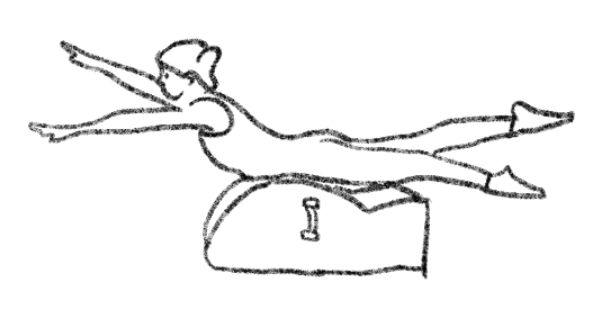
Starting position: Prone on corrector, abdomen at apex, arms extended overhead, legs extended back. Maintain slight extension in spine and hips. Breathing/Movement: With smooth breath, control lift limbs off floor and float. Alternately flex/extend opposite arm and leg, simulating swimming strokes. Imagery: Imagine floating on water, core as stable board, limbs as coordinated oars; body lengthened, gliding smoothly.
起始位:俯卧在矫正器上,腹部置于顶点,手臂向头顶方向延伸,双腿向后伸直延伸。保持脊椎与髋关节的轻微伸展。 呼吸与动作:保持流畅呼吸,有控制地将四肢抬离地面并悬浮于空中。交替对侧手臂与腿进行屈曲与伸展,模拟游泳划水动作。 想象提示:想象自己漂浮在水面上,核心是稳定的浮板,四肢是协调划动的船桨;身体像被拉长,在水面平滑前行。
IMAGERY 意象
【Direct】Axial Elongation: During alternating movement, keep the crown and tailbone reaching in opposite directions, maintaining a neutral and full spine on the SC arc. Scapular Organization: Focus on the centralized rotation of the humeral head in the socket; avoid shrugging as the arm lifts. Core Anchor: On exhale, let the pubic bone sink slightly into the SC slope, using this downward pressure to stabilize the pelvis and prevent lumbar compensation. 【Indirect】Bridge Main Pier: Imagine your torso as the solid main pier of a sea-crossing bridge; limbs are the cables reaching out, staying motionless regardless of the 'waves' (frequency). Compass Needle: View your body as a precision-calibrated compass needle; internal tension keeps the needle straight, projecting energy to the north and south poles. Clockwork Gears: Imagine your limbs as gears in an antique clock; every movement is driven by the 'mainspring' at your core, creating a crisp, isometric, and steady rhythm. 【Space】Diagonal Vertices: Reach with fingers and toes to touch and trace the four furthest diagonal vertices of the room, maximizing your spatial span. Filling Negative Space: Feel your limbs pushing through and filling the negative space (shadow areas) around the SC, making the body three-dimensional. Horizon Compass: Imagine your sternum as a compass needle pointing to the horizon; as the thoracic spine extends slightly, guide your gaze to explore the vast space ahead. 【Feeling】Cradled by Warm Clouds (Kinesthetic): Feel as if your abdomen is cradled by a warm, soft cloud; use this upward support to activate the deep core and decompress the low back. Warm Water Viscosity (Texture): Imagine moving through resistant warm water; each stroke and kick requires overcoming the viscosity of water molecules for a fluid quality. Elastic Wetsuit (Tension): Feel your fascial system as a tight, elastic wetsuit providing subtle recoil at the extremities, helping you automatically find axial length after every stroke.
【直接】中轴延伸:交替运动时,保持头顶与尾骨向相反方向持续拉长,确保脊柱在SC弧面上维持中立且饱满。肩带组织:关注肱骨头在关节窝内的中心化旋转,手臂抬起时避免肩胛骨耸起。核心锚定:呼气时耻骨轻微沉向SC斜坡面,利用向下压力稳定骨盆,防止腰椎产生过度代偿。【间接】跨海大桥主墩:想象躯干是跨海大桥的坚固主墩,四肢是向外延伸的悬索,无论风浪(动作频率)如何,主墩纹丝不动。指南针拨杆:视身体为一个正在精准校准的指南针拨杆,内在张力使拨杆保持笔直,能量向南北两极无限投射。老式挂钟齿轮:想象四肢是老式挂钟内部的齿轮组,交替运动由核心‘发条’驱动,产生清脆、等长且匀速的刻度感。【空间】触碰对角线顶点:想象指尖和趾尖正尝试触碰并画出房间对角线最远端的四个顶点,占据最大空间跨度。填满负空间:感受肢体正在推开并填满SC周围所有的负空间(阴影区域),使身体立体且向外扩张。指向地平线的罗盘针:想象胸骨是一枚指向地平线的罗盘针,随着胸椎微小伸展,平稳探索前方广阔空间。【感觉】温润云朵托举(动觉):感受腹部下方仿佛被一团温润云朵托举,利用向上支撑感激活深层核心,减轻腰部受力。温水的粘性阻力(质感):想象正处于有阻力的温水中,每一次划水和踢腿需平稳克服水分子粘性,保持丝滑连贯。弹性潜水服(张力):感受筋膜系统像一层紧致弹性的连体潜水服,在末梢提供微小回弹力,自动找回中轴长度。
TACTILE CUES 触觉提示
Lightly touch lower abdomen, cue core engagement to maintain balance on apex. During alternating strokes, lightly touch contralateral scapula and hip, cue coordinated movement. Lightly touch heels, cue legs to reach back long.
轻触练习者下腹部,提示核心收紧以维持身体在顶点上的平衡。 在交替划动时,轻触对侧肩胛骨和髋部,提示协调运动。 轻触脚跟,提示腿向后远延伸。
PROGRESSION 进阶
Reduce or eliminate fingertip contact with floor, rely entirely on core and back muscles for balance.
减少或取消手指与地面的接触,完全依赖核心与背肌控制平衡。
REGRESSION 退阶
Lightly touch fingertips to floor for tactile feedback and balance assistance.
将手指尖轻轻接触地面,以提供轻微的触觉反馈和平衡辅助。
COMMON ERRORS 常见错误
Excessive shoulder elevation/retraction (shrugging); using lumbar as hinge to lift (sagging back); head and chest dropping; lack of active thoracic extension.
肩膀过度上提或后缩(耸肩);利用腰椎作为折点下凹来推起身体(腰部塌陷);头和胸部下垂;缺乏胸椎的主动伸展。
PRECAUTIONS 注意事项
Caution for acute neck/lumbar injury; significantly regress or avoid for severe core weakness.
颈部或腰部急性损伤者慎做;核心严重无力者需大幅降阶或避免。