BENEFITS 益处
Improves trunk lateral flexion mobility and control; strengthens lateral abdominals (obliques, quadratus lumborum); improves rib mobility in frontal plane; enhances core stability in asymmetrical postures.
提高躯干侧向屈曲的灵活性与控制能力;强化侧腹肌群(腹斜肌、腰方肌)力量;改善肋骨在冠状面的活动能力;增强核心在非对称姿势下的稳定性。
TARGET MUSCLES 目标肌群
Internal/external obliques, quadratus lumborum (primary flexion/return), transversus abdominis and multifidus (deep stabilizers), contralateral obliques and QL (eccentric control), shoulder girdle stabilizers (depending on arm position).
腹内斜肌、腹外斜肌、腰方肌(主导侧屈与回正)、腹横肌与多裂肌(深层稳定)、对侧腹斜肌与腰方肌(离心控制)、肩带稳定肌群(根据手臂位置)。
SETUP 设置
Secure Spine Corrector. Adjust based on corrector's curve: more curved provides earlier support; flatter requires more core control early in movement.
将脊椎矫正器稳固放置。根据矫正器自身弧度调整预期:曲度较大的矫正器能更早为身体提供支撑;曲度平缓的矫正器则要求在动作初期有更强的核心控制。
CUES 口令
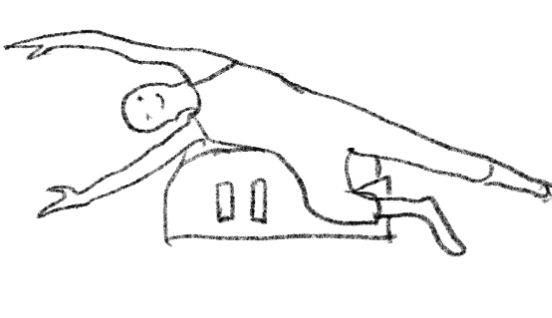
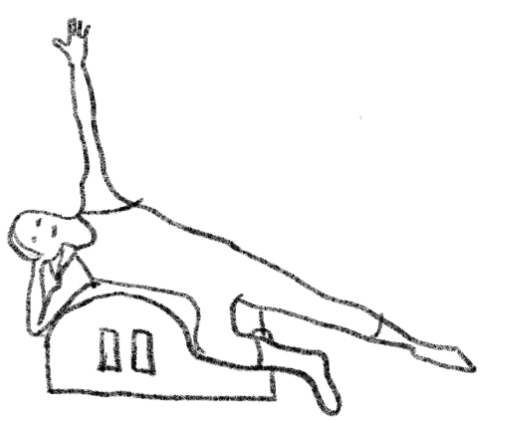
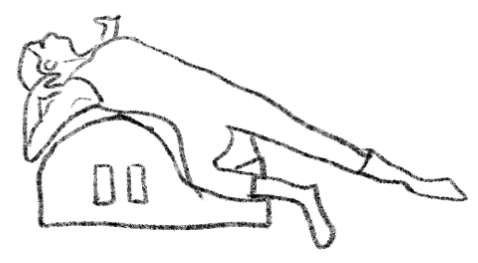
Starting position: Side-sit on corrector, hip in 'corner' (junction of apex and side). Inside leg bent, outside leg extended forward. Arm options: crossed on chest, behind head, overhead. Breathing/Movement: Inhale, prepare and lengthen spine. Exhale, engage lateral abdominals, sequentially wrap trunk over corrector's curve: hip, waist, lower ribs, upper ribs/shoulders, head. Inhale, hold at end, maintaining length. Exhale, control return in reverse order: head, shoulders, upper ribs, lower ribs, waist, hip. May exhale in both phases for more control. Imagery: Body like a wet towel gently wrung around the corrector's curve; side waist muscles like accordion bellows opening and closing evenly.
起始位:侧坐在矫正器上,髋部靠在矫正器的“角落”(顶点与侧面的交界处)。内侧腿弯曲,外侧腿向前方延伸伸直。手臂位置可选:交叉于胸前、置于头后或高举过头。 呼吸与动作:吸气,准备并延伸脊椎。吐气,启动侧腹力量,按照髋部、腰部、下段肋骨、上段肋骨与肩膀、头部的顺序,将躯干侧弯并“包裹”绕过矫正器的弧面。吸气,在侧屈末端保持延伸。吐气,按照从头、肩、上肋、下肋、腰、髋的顺序,有控制地回到起始位。可调整呼吸为向心和离心阶段都吐气,以增强核心控制。 想象提示:身体像一块湿毛巾,被轻柔地拧绕过矫正器的弧面;侧腰的肌肉像手风琴风箱一样均匀地开合。
IMAGERY 意象
【Direct】Initiation: On exhale, feel the zip-up connection between your upper ribs and iliac crest, lifting the body steadily off the arc. Alignment: Keep the nose, sternum, and pubic bone on the same midline throughout to prevent forward leaning or backward rotation. Lower Limb Anchor: Press the outer edge of the bottom foot into the floor, using the counter-pressure to stabilize the pelvis in the crevice. 【Indirect】Wind-up Metronome: Imagine your body as a wound-up metronome; with the pelvis as a fixed base, the torso swings precisely and steadily above the arc. Carbon Fiber Pole: View your spine as a flexible carbon fiber pole, conforming to the curve on the way down and displaying resilient recoil on the way up. Folding Razor: Imagine your body as an opening folding razor; the handle (pelvis) is fixed in the crevice, while the blade (torso) carves a smooth arc in the lateral plane. 【Space】Rotating Lighthouse: Imagine your crown as a rotating lighthouse beacon, sweeping its beam across the entire vertical sector of the side wall from floor to ceiling. Flat Mail Slot: Imagine squeezing into an extremely flat mail slot; all movement must occur within that narrow slit without touching the front or back walls. Filling the Diagonal Void: As you lift, inhale and attempt to fill the unoccupied void diagonally above your upper waist to achieve maximum elongation. 【Feeling】Warm Stone Suction (Tactile/Temp): Feel the arc as a magnetic warm stone; as you lower, feel each vertebra being sequentially 'suctioned' and warmed. Liquid Mercury Resistance (Texture): Imagine moving through dense liquid mercury; each ascent requires overcoming heavy, even resistance to ensure a jitter-free movement. Underarm Fountain (Buoyancy): Feel as if a cool, upward-surging spring is cradling your bottom armpit, making the start of the return trip effortless and light.
【直接】启动连结:呼气向上时,感受上侧肋骨与髂骨间像拉链一样收紧,将身体平稳拉离桶面。排列要求:全程保持鼻尖、胸骨与耻骨处于同一中垂线,防止产生前倾或后转。下肢锚定:持续将下侧腿脚外侧边缘压向地板,利用反作用力稳定骨盆在凹槽内的位置。【间接】发条节拍器:想象身体是一个上紧发条的节拍器,以骨盆为固定基座,躯干在圆弧上方进行精准匀速摆动。碳纤维撑杆:视脊柱为一根高柔韧性的碳纤维撑杆,向下侧屈时顺应弧度,向上时展现强大弹性回弹力。折叠剃刀:想象身体是一柄开启的折叠剃刀,手柄(骨盆)固定在凹槽,刀刃(躯干)在侧向平面平滑划出弧线。【空间】旋转的灯塔:想象头顶是一盏旋转的灯塔探照灯,光束正扫过侧方墙面上从地板到天花板的整个垂直扇区。扁平邮件投递口:想象正试图塞进一个极其扁平的邮件投递口,所有动作在极窄缝隙内完成,不触碰前后两壁。填满斜上虚空:向上提起时,吸气并尝试用上侧侧腰填满斜上方未被占据的虚空,获得最大延伸感。【感觉】暖石的吸附(触觉/温度):感受矫正器弧面如同一块带有引力的暖石,向下贴合时,每一节椎骨被依次“吸附”并温热。液态水银的阻力(质感):想象正处于质地稠密的液态水银中,每一次上升需克服沉重均匀的阻力,确保动作毫无抖动。腋下向上喷泉(浮力):感受下侧腋下仿佛被一股向上喷涌的微凉泉水托举,让回程启动极其轻盈省力。
TACTILE CUES 触觉提示
Lightly touch lower ribs on bending side, guide to reach away and maintain contact with corrector. Lightly touch opposite (top) hip, cue to stay stable, prevent hiking/rotation. During return, lightly touch lateral abdomen, cue contraction to pull body back.
轻触练习者侧弯方向下方的肋骨下缘,引导其向远延伸并保持与矫正器的接触。轻触其对侧(上方)髋部,提示其保持稳定,防止骨盆上提或旋转。在回正时,轻触其侧腹,提示肌肉收缩将身体拉回。
PROGRESSION 进阶
Add arm variations (e.g., arm circles during side bend). Add trunk rotation at top or during movement, like 'Book Opening'.
加入手臂动作变化(如侧屈时手臂画圈)。在动作顶端或过程中加入躯干旋转,模拟“打开书本”(Book Opening)。
REGRESSION 退阶
Reduce side bend range, focus on core initiation and rib movement. Place arms by sides, on hips, or lightly on corrector to reduce lever. Keep both legs bent, feet on floor for wider base.
减小侧屈幅度,专注于核心的启动和肋骨的活动。手臂放在体侧、叉腰或轻扶矫正器,减少杠杆作用。双腿均弯曲踩地,增加基底支撑。
COMMON ERRORS 常见错误
Unwanted spinal rotation (leaning forward/back); excessive cervical lateral flexion or head leading; disconnection between ribs and pelvis (core relaxation, rib flaring or pelvic tilt).
出现不应有的脊椎旋转(变成前倾或后仰);颈椎过度侧屈代偿或用头部带动动作;肋骨与骨盆的连接中断(核心松弛,肋骨外翻或骨盆倾斜)。
PRECAUTIONS 注意事项
Severe scoliosis requires professional assessment; avoid for rib fractures or intercostal neuralgia; pregnant women need professional guidance to modify.
严重脊柱侧弯需在专业评估下进行;肋骨骨折或肋间神经痛者需避免;孕期女性需在专业指导下调整姿势。