BENEFITS 益处
Improves thoracic and lumbar extension mobility; strengthens spinal extensors; improves dynamic core control in prone position.
改善胸椎和腰椎的伸展活动度;增强脊椎伸肌力量;提高核心在俯卧位下的动态控制能力。
TARGET MUSCLES 目标肌群
Erector spinae (especially thoracic), multifidus (segmental control), gluteus maximus and hamstrings (synergistic hip extension), shoulder girdle stabilizers (serratus anterior, lower trapezius to maintain arm position).
竖脊肌(特别是胸椎段)、多裂肌(控制分节)、臀大肌与腘绳肌(协同髋部伸展)、肩带稳定肌群(前锯肌、下斜方肌以维持手臂位置)。
SETUP 设置
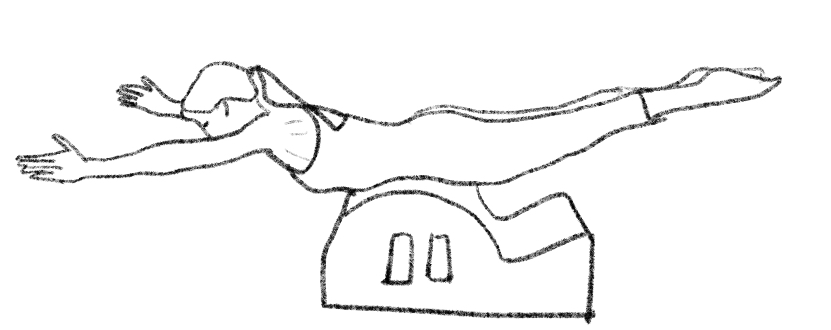
Place Spine Corrector securely; adjust body so that abdomen (navel area) is at the highest point (apex) of the corrector; legs straight, may be on platform or floor for support.
将脊椎矫正器稳固放置;调整身体位置,使腹部(脐部区域)位于矫正器的最高点(顶端);双腿伸直,可根据需要放在平台或地面上以提供支撑。
CUES 口令
Starting position: Prone on corrector, abdomen at apex, legs straight on platform/floor. Arms extended overhead. Spine in natural slight extension. Breathing: Exhale, initiate forward rock (toward flexion); Inhale, initiate backward rock (toward extension). Let breath guide rhythm. Imagery: Body like a crescent moon, gracefully arching and lengthening from the center; spine undulates like a wave, movement smooth and connected.
起始位:俯卧在矫正器上,腹部置于顶端,双腿伸直放于平台或地面。手臂举过头伸直。脊椎保持自然的轻微后仰伸展。 呼吸:吐气时,启动身体向前摇动(趋向屈曲);吸气时,启动身体向后摇动(趋向伸展)。以呼吸引导动作节奏。 想象提示:想象身体像一轮新月,从腹部向两端优雅地弯曲与伸展;脊椎如波浪般起伏,动作流畅而连贯。
IMAGERY 意象
【Direct】Initiation: On exhale, draw in abdominals for support; lead the crown toward the high corner of the front wall, peeling the spine off the arc segmentally from the neck. Alignment: At the peak, maintain light contact between the lower ribs and the apparatus to ensure extension is localized in the thoracic spine. Lower Limb Anchor: Feel the pubic bone sinking into the well, while the legs reach infinitely back as a natural extension of the spine's length. 【Indirect】Launching Glider: Imagine your body as a glider taking flight; the thorax is the nose piercing the wind upward, while the legs provide balancing tension as the tail. Carbon Fiber Rod: View your spine as a high-flexibility carbon fiber rod, forming a perfectly smooth, crease-free mechanical arc in space. Compass Needle: Imagine your chest as a poised compass needle always pointing toward the open horizon, guiding your dynamic alignment through axial elongation. 【Space】Panoramic Searchlight: Imagine your sternum as a low-angle searchlight, sweeping light from the floor to the distant horizon rather than directly at the ceiling. Lateral Rib Expansion: Inhale at the top, imagining your side ribs widening toward the side walls, filling the air layers around your body. Piercing Boundaries: Feel energy spilling from your crown to touch and pierce invisible distant boundaries, maximizing your vertical and horizontal lifeline. 【Feeling】Wooden Buoy (Buoyancy/Kinesthetic): Feel your thorax as a wooden buoy rising in water; let the natural buoyancy of your breath offset any heaviness, making the extension feel weightless. Warm Mold with Suction (Texture): Feel the arc as a warm mold with subtle gravity; as you lift, you are overcoming a delicate viscous resistance for a smooth, controlled quality. Resonating Bass String (Tension): Imagine a double bass string resonating inside you from crown to toe, maintaining a crisp, elastic tension throughout the exercise.
【直接】启动序列:呼气收缩腹壁提供支撑,引导头顶向斜前方墙角延伸,由颈椎开始带动胸椎逐节离开圆弧面。对位要求:升至最高点时保持肋骨下缘与器械表面的轻微接触,确保伸展均匀分布在胸椎段。下肢锚定:持续感受耻骨向矫正器凹槽深处下沉,双腿向后无限拉长,作为脊柱长度的自然延续。【间接】起飞的滑翔机:想象身体是一架轻盈起飞的滑翔机,胸廓作为机头平稳破风向上,双腿作为机尾提供平衡张力。碳纤维支撑杆:视脊柱为一根高柔韧性的碳纤维支撑杆,在空间中呈现出极致圆润且无折痕的力学弧度。蓄势待发的罗盘:想象胸腔是一个蓄势待发的罗盘指针,始终指向前方开阔领域,引领全身的动态对齐。【空间】全景探照灯:想象胸骨是一盏低角度全景探照灯,灯光从地板平滑扫向远方地平线,而非射向天花板。横向拓宽的侧肋:伸展位吸气,想象侧肋向房间左右两壁横向拓宽,填满身体周围所有的空气层。穿透远端边界:感受能量从头顶溢出,去触碰并穿透空间中看不见的远端边界,拉开最大的生命线。【感觉】水中的木质浮标(浮力/动觉):感受胸廓像一个在水中缓慢升起的木质浮标,呼吸产生的自然浮力抵消沉重感,让伸展极其轻盈。带引力的温润模具(质感):感受圆弧面如同带引力的温润模具,向上卷起时是在克服一种细腻粘性阻力,确保质感丝滑受控。谐振的低音提琴弦(张力):想象体内有一根从头顶拉到脚尖的谐振低音提琴弦,始终保持清脆且富有弹性的张力。
TACTILE CUES 触觉提示
Lightly touch between client's scapulae to guide thoracic extension forward and up. Lightly touch sacrum to cue pelvic stability, avoid excessive tilt. During rock, gently support hips to help sense initiation and balance.;4.Stand in front and support their hands with both of your hands.
轻触练习者肩胛骨之间,引导胸椎向上向前伸展。 轻触其骶骨,提示骨盆保持稳定,避免过度前倾或后倾。 在摇动时,双手轻扶其髋部两侧,辅助感知动作的启动与平衡。站在前方双手托住其双手
PROGRESSION 进阶
Reach arms back toward feet, increasing lever length to challenge back muscles and core stability.
手臂向后往脚的方向延伸,增加杠杆长度,从而加大对背部肌群和核心稳定性的挑战。
REGRESSION 退阶
Place hands on floor for extra support, reducing demand on core and back; or reduce rocking range.
双手撑在地上,提供额外的支撑,减少对核心和背部力量的需求;或减小摇动的幅度。
COMMON ERRORS 常见错误
Excessive cervical/lumbar extension (compression); insufficient thoracic extension causing 'broken' shape; stiff movement of spine and hips together, lacking articulation; using head or arms to initiate instead of breath and core.
颈椎或腰椎过度后仰伸展(挤压);胸椎伸展不足,导致身体失去新月形状(折腰);脊椎和髋部同时僵硬运动,缺乏分节与控制;利用头部或手臂的摆动来带动动作,而非由呼吸和核心启动。
PRECAUTIONS 注意事项
Avoid for acute cervical/lumbar disc herniation, spondylolisthesis, osteoporosis; caution for pregnancy (especially 2nd/3rd trimester); modify arm position/range for shoulder injury/pain.
颈椎或腰椎间盘突出急性期、脊椎滑脱、骨质疏松症患者应避免;孕妇(尤其孕中期后)慎做;肩部受伤或疼痛者需调整手臂位置或幅度。