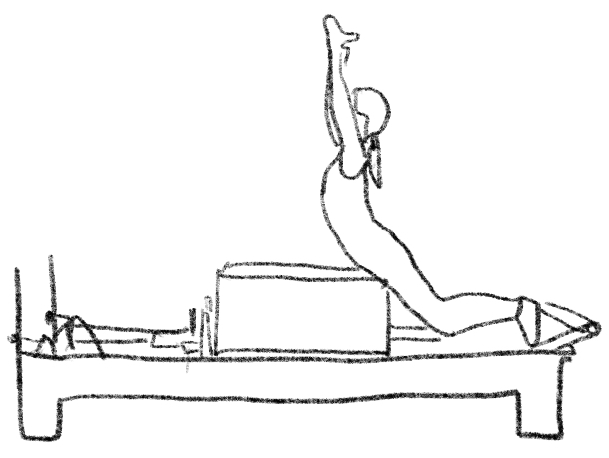
BENEFITS 益处
Improves back extensor strength, enhances spinal flexibility, strengthens hip extension, reinforces shoulder girdle stability.
改善背部伸展肌群力量、提高脊柱灵活性、加强髋关节伸展能力、强化肩带稳定性。
TARGET MUSCLES 目标肌群
Back extensors, gluteus maximus, hamstrings, serratus anterior, lower trapezius.
背部伸展肌群、臀大肌、腘绳肌、前锯肌、斜方肌下部。
SETUP 设置
Springs: 1/2-2 springs; foot bar down; long box placed lengthwise on carriage.
【弹簧】1/2-2根弹簧;脚踏杆放下;长箱以长轴方向放在滑板上。
CUES 口令
[Starting Position] Lie prone on the box with the upper thighs and the area just below the pubic bone at the edge of the box ;Keep the body weight in the legs, avoiding direct pressure on the pubic bone ;Extend legs at a 45-degree angle, with the balls of the feet against the inside of the frame ;[Breathing] Exhale: Push through the feet to move the carriage forward, extending the body into a diagonal straight line ;Inhale: Thoracic extension (arch back) ;Exhale: Return to the lengthened diagonal line ;Inhale: Thoracic extension, bend the knees, and lift the body up and over into a back extension ;Maintain constant axial elongation; do not slide off the box ;Exhale: Straighten the legs, extend the torso back to the diagonal line, then lower to the starting position as the knees bend ;[Variation]: On some Reformers, placing the feet on the footbar may be more appropriate than the inside of the frame
【起始位】俯卧在箱子上,大腿上方和耻骨下方在箱子边缘,身体重量在双腿上,不要压在耻骨。腿伸直45度角,脚球抵在床框内。【呼吸】吐气:脚推床,让滑床往前运动,身体呈斜对角直线延伸。吸气:胸椎伸展后仰。吐气:回到拉长的斜角直线。吸气:胸椎伸展后仰,膝盖弯曲,身体往上绕过往后弯。【提示】保持身体持续拉伸,不要从箱子上滑下来。吐气,双腿伸直,躯干延伸到斜角直线,然后往下倒开始姿势,膝盖弯曲。【变化】用有些核心床练习时,脚踩住脚踏杆比踩床框内缘合适。【预热】step1:仅屈伸腿,step2:在step1的基础上加上手,step3:手扶在滑床两侧,屈伸腿时做胸伸
IMAGERY 意象
【Direct Imagery】Axial Elongation: Constantly reach the crown of your head toward the far wall in front of you while lengthening the tailbone backward. Shoulder Girdle Organization: Actively broaden your collarbones to the sides, increasing the space between your shoulders. Spinal Segmentation: Initiate from the sternum, peeling the spine up away from the long box one vertebra at a time. 【Indirect Imagery】Principle: Use metaphors or analogies to visualize body parts as objects, triggering spontaneous neuromuscular responses. Ribcage Alignment: Imagine your collarbones are flashing a brilliant smile as wide as your shoulders. Spinal Resilience: Let your spine be like a flexible bamboo pole, arching evenly toward the horizon. Total Suspension: Imagine your head is a helium-filled balloon, effortlessly floating your upper body upward. 【Spatial Imagery】Principle: Use 3D space, dimensions, and distance to guide the amplitude and quality of movement. Length Challenge: Imagine your fingertips and toes reaching for opposite ends of the room, filling the entire space with your body. Arc Trajectory: Trace a massive rainbow arch through space with your body. Outward Expansion: As you inhale, feel your ribs expanding in all directions like an opening umbrella. 【Sensory Imagery】Principle: Engage tactile, kinesthetic, and auditory senses to alter the movement's texture. Tactile (Melting): On the return, feel your abdomen and chest smoothing back onto the long box like melting butter. Kinesthetic (Resistance): Imagine moving through thick molasses. every push and pull should have a weighted, steady quality. Auditory (Flow): Inhale with a 'swoosh' sound, feeling the energy flow from your toes all the way to the crown of your head.
【直接】中轴延伸:将头顶不断向前方远处的墙壁延伸,同时尾骨向后方拉长。肩带组织:主动让你的锁骨向两侧变宽,增加两肩之间的空间。脊椎分节:从胸骨开始启动,让脊椎一节一节地向上卷动离开长箱。【间接】原则:使用比喻或隐喻,将身体部位形象化为其他物体,以诱发神经肌肉的自发反应。胸廓排列:想象你的锁骨正展现一个灿烂的微笑,笑容的宽度与肩膀一致。脊椎弹性:让你的脊柱像一根弹力十足的长竹竿,均匀地向远处弯曲成拱形。整体悬浮感:想象你的头是一个充满氦气的气球,正带着你的上半身轻盈地向上飘浮。【空间】原则:利用三维空间、尺寸和距离的概念,引导动作的幅度和质量。长度挑战:想象你的指尖和脚尖正在够到房间的两端,让身体充满整个空间。弧线轨迹:用你的身体在空间中划出一个巨大的彩虹拱门。向外扩张:吸气时,感觉你的肋骨像一顶撑开的雨伞,向三维空间的各个方向扩张。【感觉】原则:调动触觉、动觉、听觉等感官体验,改变运动的质感。触觉(融化):在返回时,感觉你的腹部和胸部像融化的黄油一样,平顺地铺回到长箱上。动觉(阻力):想象你在浓稠的糖蜜中移动,每一个推起和拉回的过程都带有沉稳的质感。听觉(流动):吸气时发出‘swoosh’(嗖嗖)的声音,感受能量从脚尖一直流向头顶。
TACTILE CUES 触觉提示
Hand on thoracic spine to guide extension; lightly touch abdominals to cue core support, avoiding lumbar hyperextension; press ankles for stability.
手置于胸椎处指引伸展;轻触腹部提示核心支撑避免腰椎过伸;手按压脚踝增强稳定性。
PROGRESSION 进阶
Single Leg Variation: Add dynamic lower limb movement (such as single-leg curls) while maintaining the Swan extension to challenge pelvic stability and core control ;Adjust Foot Placement: Move the feet from the inside of the Reformer frame to the Footbar; this alters the lever length and center of gravity, increasing the demand on the posterior chain ;Swan with Rotation: Introduce thoracic rotation during the extension phase While challenging on the Long Box, this is a common advanced progression on the Wunda Chair or Ladder Barrel to improve stability for functional sports like golf or tennis ;Long Box Series Integration: Sequence the Swan with other Advanced 2 exercises like Backstroke or Teaser to challenge precision and control during complex transitions ;Ladder Barrel Grasshopper: A high-level spinal extension challenge that mimics the suspension feel of the Swan but requires significantly greater posterior chain strength and endurance
增加单腿屈伸变式 (Single Leg Variation):在维持天鹅式伸展位的同时,加入下肢的动态位移(如单腿屈伸),挑战骨盆稳定性和核心控制力。调整足部放置位置:将脚从核心床框架内缘移至脚踏杆 (Footbar) 上,这会改变身体的力矩和重心,增加对后侧链肌群的挑战。Swan with Rotation (天鹅式带旋转):在伸展位引入胸椎旋转。虽然长箱上操作较难,但常作为同级别在万能椅或梯桶上的高级进阶变式出现,以提升功能性运动(如高尔夫、网球)所需的稳定性。整合 Long Box 系列动作:将 Swan 与同属 Advanced 2 级别的 Backstroke 或 Teaser 整合进一个序列中,挑战在不同体位转换间的精准控制力。Ladder Barrel Grasshopper (梯桶蚱蜢式):作为脊柱伸展的高级挑战,其身体悬空感与 Swan 类似,但要求更高的后侧链肌力与耐力。
REGRESSION 退阶
Reduce extension range; decrease spring tension; adjust box position.
减小伸展幅度;减少弹簧阻力;调整箱子位置。
COMMON ERRORS 常见错误
Excessive cervical extension/flexion; excessive lumbar extension; lack of axial elongation; unwanted shoulder elevation; sliding off box; knees collapsing inward when bent.
颈椎过度后仰或前弯;腰椎过度后仰伸展;没有中轴延伸;不该有的肩带上提;从箱子上滑下来;屈膝时膝盖内扣。
PRECAUTIONS 注意事项
The Swan is a classic spinal extension exercise; individuals with contraindications for back extension should avoid or perform this movement with extreme caution. Spinal Stenosis: The pathways through which nerve roots exit the spinal cord (spinal canal or intervertebral foramina) are narrowed; spinal extension typically exacerbates symptoms such as back pain, tingling, or numbness. Spondylolisthesis: A fracture in the pars interarticularis of the facet joint causes the affected vertebra to shift forward. Spinal extension usually worsens the slippage, leading to spinal cord or nerve root compression. Facet Joint Syndrome: Characterized by hypomobility or 'locking' of the facet joints in the posterior spine; extending the affected joint is a definitive contraindication. Acute Disc Herniation: During the acute phase, any spinal movement under load (including extension) may cause discomfort or neurological symptoms; medical advice should be followed.
Swan 是一个典型的脊柱伸展动作,属于后仰禁忌的人群应避免或极其谨慎地进行此动作。脊椎狭窄 (Stenosis):神经根从脊髓出来的路径(脊椎管道或椎间孔)受狭窄影响,脊柱伸展动作通常会造成症状加剧,如背痛、刺痛或麻木感。脊椎滑脱症 (Spondylolisthesis):在椎弓小关节处的椎弓有断裂,导致受影响的脊椎向前位移。通常脊椎的后仰伸展会加剧滑脱,造成脊髓或神经根受压。小面关节症候群 (Facet Joint Syndrome):脊椎后部的小面关节活动度过低或被卡住,伸展受损同侧的小面关节是一个明确的禁忌。急性椎间盘突出 (Acute Disc Herniation):在急性期,任何负重下的脊柱运动(包括伸展)都可能引起不适导致神经症状,应遵医嘱。