BENEFITS 益处
Strengthen back extensors; improve scapular stability; enhance body control in a kneeling position. Postural improvement: Correct forward head posture and thoracic kyphosis, promoting axial elongation. Sport-specific training: Provide muscular support for sports requiring dynamic shoulder control, such as tennis serves or golf swings.
加强背部伸肌力量;改善肩胛稳定性;提高跪姿下的身体控制力。改善体态:纠正头前引与胸椎后凸,促进中轴延伸。专项训练:为网球发球或高尔夫挥杆等需要肩部动态控制的运动提供肌力支持。
TARGET MUSCLES 目标肌群
Mover Muscles: Triceps (pressing back), biceps (curls), posterior deltoids, rhomboids, middle and lower trapezius, latissimus dorsi. Stabilizer Muscles: Rotator cuff group (maintaining congruent alignment of the humeral head within the glenoid fossa), internal/external obliques, transversus abdominis, deep cervical flexors (during Chest Expansion).
动力肌:肱三头肌(后推)、肱二头肌(弯举)、三角肌后束、菱形肌、中下斜方肌、背阔肌。稳定肌:肩袖肌群(维持肱骨头在关节窝内的和谐对位)、腹内/外斜肌、腹横肌、颈部深层屈肌(扩胸时)。
SETUP 设置
1/2-1 spring. short straps with handles or loops.
1/2-1 弹簧。短拉绳加把手或套环。
CUES 口令
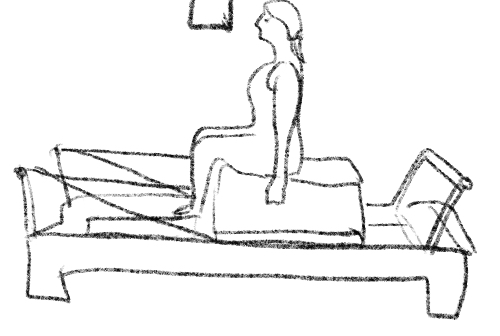
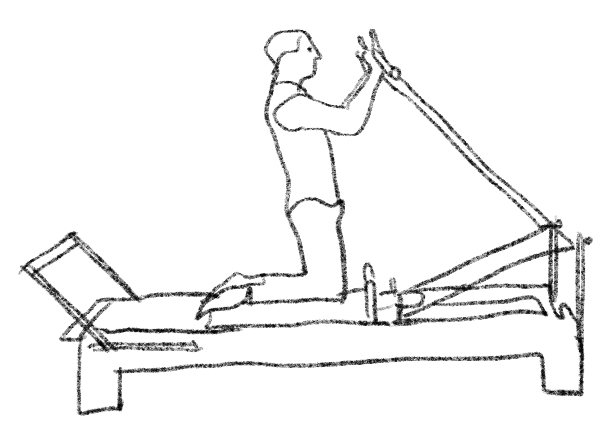
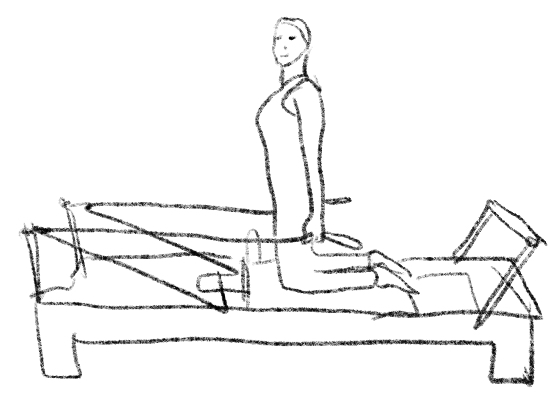
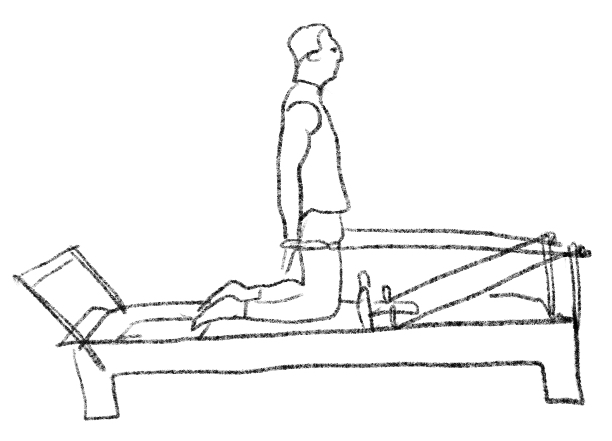
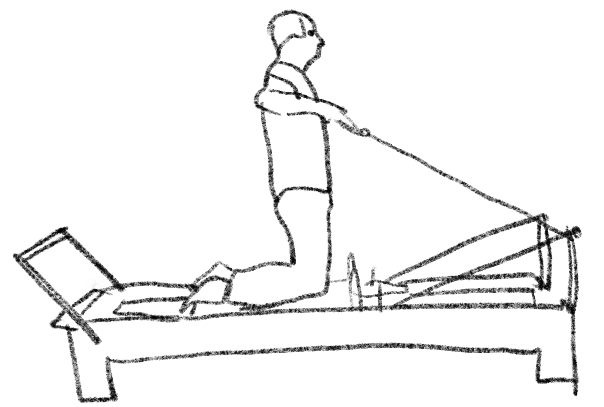
【Starting Position】Seated or high kneeling, facing the head of the Reformer (back to the footbar). Hold the straps with palms facing back. Arms extended forward, lower than shoulder height. 【Safety Considerations】Cue the client to maintain balance and move smoothly. The instructor should guard the client's sternum until they master the dynamic phase (eg, one hand on the sternum, one near the sacrum). 【Movement/Breathing Recommendations】 【Press Back - Arms Straight】 Exhale: Press arms back just past the side seams of the clothing, maintaining congruent alignment of the humerus within the glenoid fossa. Inhale: Return to starting position. 【Biceps Curls】 Palms up, elbows at shoulder height or a comfortable level. Exhale: Bend elbows, pulling straps toward shoulders while keeping elbows stationary. 【Rows - Cords Crossed】 Exhale: Adduct the scapulae, pull elbows back while keeping hands in front of the torso, arms parallel to the floor. 【Chest Expansion】 Inhale: Press arms back, widening the collarbones. Hold the position, rotate the head right then left, then return to center. Exhale: Return arms to starting position. Alternate the head rotation sequence on the next repetition. 【Variations】 Sit on a Long Box. Adjust the height of the risers to change the angle of resistance.
【起始位】坐姿或高跪姿面向核心床头的方向(即背对脚踏杆的方向)。手握把手,手心朝后。手臂伸直往前,高度低于肩膀。【安全考量】提示客户保持平衡,动作平顺。教练保持手在客户胸骨位置保护她,直到客户了解动作的动态部分(即一手放她胸骨上,一手靠近她骶骨)。【动作/呼吸建议】【Press Back-后推-手臂伸直】吐气时,手臂后推到刚过衣服侧边缝线的位置,肱骨头在肩关节窝中协调对位。吸气时,回到起始位置。【Biceps Curls 二头肌练习】手心朝上,手肘与肩膀等高或是在舒适的高度。吐气,手肘弯曲,把手往肩膀拉,手肘不动。【Rows - cords crossed 划船-拉绳交叉】吐气时,肩胛内收,手肘往后,手保持在躯干前方,手臂与地板平行。【Chest Expansion 胸扩展】吸气时,手臂往后推,锁骨展开。保持姿势不动,头往右往左转,再回到中间。吐气时,手臂回到起始位置。重复练习时,头先往左再往右看。【变化】坐在大箱子上练习。可改变拉绳的高度,改变阻力的角度。
IMAGERY 意象
【Direct】As the arms press back, focus on rotating the humeral head within the center of the joint socket to prevent anterior gliding, while keeping the sternum soft and slightly heavy. During arm extension, actively widen the collarbones and feel the alignment between the atlas and the center of the knees on the vertical gravity line. Maintain a constant vertical distance between the lower rib margin and the ASIS, ensuring the spine remains neutral during reciprocal arm movements. 【Indirect】Mast in the Deep Sea: Imagine your torso as the mast of a great ship sailing in the deep sea; though the strap tension strikes like a gale, the mast remains its structural integrity and verticality. Ancient Scales: The arms are like the ends of precision scales; during alternating rowing, the core as the central fulcrum must be rock-solid. Unfolding Wings: Imagine your back spreading a pair of heavy, broad wings to either side; this lateral tension helps stabilize the scapulae without shrugging. 【Space】Stereoscopic Backdrop: Feel an invisible stereoscopic sensor wall behind you; as the arms press back, use the back of your hands to evenly 'smooth out' its texture, ensuring absolute symmetry. Filling the Internal Sphere: During bicep curls, imagine a slowly expanding transparent sphere inside your chest, using breath to fill the posterior space of the sphere. Diagonal Anchoring: Feel the apex of your crown piercing the void above while the shins and tops of the feet embed deep into the carriage, establishing a bi-directionally extending energy axis. 【Feeling】Heavy Velvet: Feel the air around you becoming resistant like heavy velvet fabric; when returning the carriage, you must controlledly 'iron out' the wrinkles in the fabric. Cool Spring in the Neck: During chest expansion with head rotation, imagine a cool spring flowing between the cervical vertebrae, washing away all compression and tightness. Ripples at the Fingertips: As the fingertips sweep back, feel as if you are creating symmetrical ripples on a calm lake, using this fine touch to monitor the equality of force in both hands.
【直接】当手臂向后推时,专注于让肱骨头在关节窝中心旋转,防止其向前顶出,同时保持胸骨柔软并微向下沉。在手臂后伸时,主动向两侧展宽锁骨,并感受寰椎与膝盖中心在垂直引力线上建立对位。保持肋骨下缘与骨盆髂前上棘之间的垂直距离恒定,确保脊柱在中立位下进行手臂的往复运动。【间接】深海中的桅杆:想象你的躯干是航行在深海中的巨轮桅杆;尽管拉带的拉力像狂风般拍打,但桅杆始终保持其结构强度与垂直度。古老的天平:双臂如同精密天平的两端;在交替划船时,核心作为中心支点必须稳如磐石。展开的羽翼:想象你的背部正在向两侧撑开一对沉重而宽阔的羽翼,这种横向的张力能帮助你稳定肩胛骨。【空间】背后的立体幕墙:感觉你背后有一面无形的立体感应幕墙;当手臂后推时,用你的手背去均匀地刷平幕墙上的纹理,确保动作轨迹绝对对称。填充内部球体:在做二头肌转圈时,想象你的胸腔内部有一个正在缓慢膨胀的透明球体,用呼吸去填满球体的后侧空间。对角线锚定:感受头顶的顶点正刺破上方虚空,而胫骨与足背则深嵌入滑车垫层,建立起一根双向延展的能量轴。【感觉】厚重的丝绒:感受你周围的空气变得像厚重的丝绒布料一样具有阻力;在还原滑车时,你必须有控制地熨平布料的褶皱。颈部的清泉:在做扩胸转头练习时,想象颈椎骨之间流过一股清凉的泉水,带走所有关节的挤压与紧绷。指尖的涟漪:当指尖向后划过时,感觉像是在平静的湖面上激起对称的涟漪,用精细触觉监控双手受力的均等性。
TACTILE CUES 触觉提示
One hand on the sternum, one hand near the sacrum.
一手放胸骨,一手放在靠近骶骨的位置
PROGRESSION 进阶
Perform in a high kneeling position to reduce the base of support and increase the core challenge. Incorporate more complex head and neck movements during Chest Expansion.
高跪姿执行,减少支撑基底,增加核心挑战。或在扩胸中加入更复杂的头颈动作。
REGRESSION 退阶
Sit on a Long Box or Short Box to increase the support surface, reducing the demand on balance and hip control.
坐于长箱或短箱上练习,增加支撑面,降低对平衡及髋部控制的要求。
COMMON ERRORS 常见错误
Collapse of the chest; spinal rotation, flexion, or extension; rib flaring; anterior gliding of the humeral head within the glenoid fossa; loss of axial elongation; leaning the torso forward or backward; excessive wrist flexion or hyperextension; loss of shoulder congruent alignment; excessive shoulder protraction or elevation; moving too quickly and losing balance.
胸口塌陷;脊椎旋转、前弯或后仰;肋骨外翻;肱骨头在关节窝中往前顶;失去中轴延伸;躯干往前或往后倾;手腕过度屈曲或伸展后仰;失去肩关节协调对位,肩过度前引或上提;动作太快失去平衡。
PRECAUTIONS 注意事项
Knee joint conditions (for those with limited kneeling capacity), acute phase of rotator cuff injury. High kneeling is not permitted for individuals with knee or ankle injuries.
膝关节病症(跪姿受限者)、肩袖损伤急性期。膝脚踝受伤的不能高跪姿。