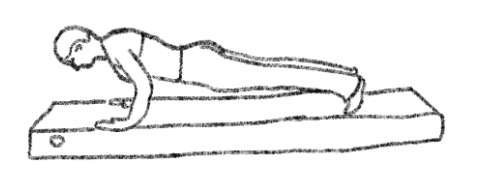
BENEFITS 益处
Strengthens upper body pushing muscles (chest, shoulders, triceps); enhances core and shoulder girdle stability; improves overall body control in dynamic movement; enhances coordination of spinal articulation in flexion/extension.
强化上肢推力肌群(胸、肩、三头肌);增强核心与肩带的稳定性;改善身体在动态中的整体控制能力;提高脊椎分节屈伸的协调性。
TARGET MUSCLES 目标肌群
Pectoralis major, anterior deltoid, triceps (primary pushing muscles), transversus abdominis and rectus abdominis (core stability for plank), serratus anterior and lower trapezius (scapular stability), erector spinae (control roll), hip flexors and hamstrings (assist roll and stability).
胸大肌、三角肌前束、肱三头肌(主要推力肌群)、腹横肌与腹直肌(核心稳定以维持平板)、前锯肌与下斜方肌(肩胛稳定)、竖脊肌(控制卷动)、髋屈肌与腘绳肌(辅助卷动与稳定)。
SETUP 设置
None. May practice against wall for stability.
无。可靠墙练习以增加稳定性。
CUES 口令
Starting position: Stand, feet parallel together. Imagine a wall behind. Breathing/Movement: Exhale, initiate with a nod, articulate spine forward segmentally, weight on balls of feet, until hands reach floor or in front of legs. Walk hands forward into plank position (hands under shoulders, body straight line). Inhale, maintaining plank, lower body toward floor (bend elbows). Exhale, push body up. Then walk hands back toward feet. Pause, inhale. Exhale, articulate spine up from tailbone, stacking vertebrae, return to stand. Imagery: Rolling down like wallpaper peeling; in plank, body like a solid board; rolling up like stringing pearls with spine.
起始位:站立,两腿平行并拢。想象身体后面有一面墙。 呼吸与动作:吐气,从点头开始引导脊椎一节一节向前卷下,保持重心在前脚掌,直到双手接触地面或置于腿前方。双手向前行走,直至身体呈平板支撑姿势(手在肩下方,身体一条直线)。吸气,保持身体平板不塌陷,躯干向地板方向下降(屈肘)。吐气,将身体推起。然后双手向脚的方向往回走。暂停片刻,吸气。吐气,脊椎从尾骨开始一节一节向上卷回,堆叠椎块,回到站立姿势。 想象提示:向下卷时,像墙纸从墙上剥离;平板时,身体像一块坚固的木板;向上卷时,像用脊椎串起珍珠。
IMAGERY 意象
Direct: Feel coordinated spinal articulation and upper body push. Indirect: Like a folding bridge, smoothly extending and retracting. Space: Imagine body moving within a transparent rectangular box during roll and push-ups. Feeling: Focus on weight distribution on feet, continuous core engagement, and chest contraction during push-ups.
直接:感受脊椎逐节卷动和上肢推力的协调配合。间接:像一座可折叠的桥,平稳展开再收回。空间:想象身体在卷动和俯卧撑时始终处于一个透明的长方体中,边缘清晰。感觉:注意力放在重心在足底的分布、核心的持续收紧以及上肢推起时胸肌的收缩感上。
TACTILE CUES 触觉提示
1. During roll down, lightly touch sacrum, guide segmental movement. 2. In plank, lightly place hands on pelvis, cue to stay stable, avoid sagging. 3. During push-up descent, lightly touch upper back, guide to keep body straight. 4. During roll up, gently support sacrum, guide initiation.
1. 在卷下时,一手轻触练习者骶骨,引导其逐节运动。2. 在平板位,双手轻扶其骨盆两侧,提示保持稳定,避免塌腰。3. 在俯卧撑下降时,轻触其上背部,引导其保持身体直线。4. 在卷上时,一手轻托其骶骨,引导启动。
PROGRESSION 进阶
1. Increase number or difficulty of push-ups (eg: narrow, wide). 2. Increase tempo while maintaining control. 3. Add single-leg lifts in plank.
1. 俯卧撑阶段增加次数或难度(如窄距、宽距)。2. 加快动作节奏,同时保持控制。3. 在平板位置加入单腿抬起。
REGRESSION 退阶
1. Perform only the standing roll down part. 2. During push-ups, keep knees on floor. 3. Allow slight knee bend during roll up/down. 4. Practice against wall to reduce gravity and balance demands.
1. 只做站立下卷部分。2. 俯卧撑时膝盖弯曲着地。3. 卷上/卷下时允许膝盖微屈。4. 靠墙练习以减少对重力和平衡的要求。
COMMON ERRORS 常见错误
Weight shifting to heels; excessive cervical flexion; excessive posterior pelvic tilt; knee hyperextension; body collapsing in plank (core failure); shoulder elevation or excessive protraction.
重心向后移至脚跟;颈椎过度前屈;骨盆过度后收;膝关节超伸;平板时身体塌陷(核心失守);肩膀上提或过度前引。
PRECAUTIONS 注意事项
Caution for hypertension, vertigo, glaucoma (head below heart). Avoid or regress for acute wrist or shoulder injury. Avoid large flexion for acute lumbar disc herniation.
高血压、眩晕症、青光眼患者慎做(头部低于心脏)。手腕、肩部急性损伤者避免或降阶。腰椎间盘突出急性期者避免大幅度前屈。