BENEFITS 益处
Strengthens hamstrings and back extensors; enhances dynamic core stability in prone; improves coordinated control of shoulder and pelvic girdles; strengthens overall posterior chain.
强化腿后侧肌群(腘绳肌)和背部伸肌群;增强核心在俯卧位下的动态稳定性;改善肩带和骨盆带的协调控制;提高身体后链的整体力量。
TARGET MUSCLES 目标肌群
Hamstrings (active knee flexion), gluteus maximus (synergistic hip extension), erector spinae (primary spinal extension), transversus abdominis and multifidus (core stability), serratus anterior and lower trapezius (scapular stability), posterior deltoid (arm extension back).
腘绳肌(主动屈膝)、臀大肌(协同髋伸)、竖脊肌(主导脊椎伸展)、腹横肌与多裂肌(核心稳定)、前锯肌与下斜方肌(肩胛稳定)、三角肌后束(手臂后伸)。
SETUP 设置
None. For limited shoulder range, may use a strap.
无。肩关节活动范围受限者可使用绳带辅助。
CUES 口令
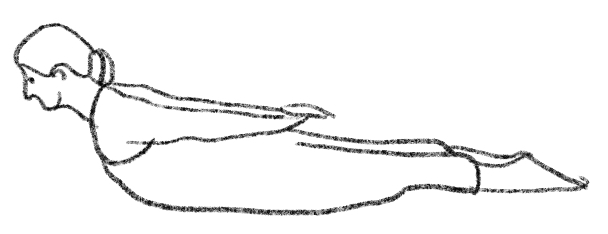
Starting position: Prone, hands overlapped on lower back, elbows toward floor. Legs straight together. Head turned to one side, cheek resting on mat. Pelvis neutral. Breathing/Movement: Inhale, bend both knees, quickly pull heels toward glutes, tapping three times, body and head relaxed on mat. Exhale, draw abdominals up and in, actively extend legs and spine, reach hands toward ankles, gaze at floor. Inhale, relax back to start. Each time lowering, turn head to other side. Imagery: Legs like strong springs, quickly compressing (knee bend) then powerfully extending; arms reaching back like drawing body into a full bow.
起始位:俯卧,双手交叠放在下背部,手肘朝向地板。双腿伸直并拢。头部转向一侧,脸颊轻松放在地板上。骨盆保持中立位。 呼吸与动作:吸气,弯曲双膝,将脚跟快速拉向臀部,连续拍打三次(如资料中“拍三下”),此时身体和头部保持放松在地板上。吐气,腹部向上提起收紧,同时双腿和脊椎主动伸展,双手向脚踝方向延伸,眼睛看向地板。吸气,放松回到起始位。每当身体下落时,头部转向另一侧。 想象提示:想象双腿像有力的弹簧,快速压缩(屈膝)再有力弹开(伸展);手臂向后延伸时,像要将身体拉成一张饱满的弓。
IMAGERY 意象
Direct: Feel rapid hamstring contraction and powerful back extension. Indirect: Like a dolphin leaping, body flexing and extending smoothly. Space: Imagine body like a bow, drawn and released, full of elasticity. Feeling: Focus on core support and extension initiated from thoracic spine.
直接:感受腿后侧的快速收缩和背部的有力伸展。间接:像海豚跃出水面,身体流畅地屈伸。空间:想象身体像一张被拉满又松开的弓,充满弹性。感觉:注意力放在核心收紧的支撑感,以及从胸椎发起的伸展感上。
TACTILE CUES 触觉提示
1. During knee taps, lightly touch hamstrings, cue quick contraction. 2. During extension, lightly place hands on medial scapulae and sacrum, guide upward extension and alignment. 3. Lightly touch lower abdomen, cue core engagement to protect lumbar.
1. 在屈膝拍打时,轻触练习者腘绳肌(大腿后侧),引导其快速收缩。2. 在伸展阶段,双手轻放在其肩胛骨内侧缘和骶骨,引导其向上延展并保持对齐。3. 轻触其下腹部,提示核心收紧以保护腰椎。
PROGRESSION 进阶
1. Increase hip and thoracic extension range (lift upper back and legs higher in extension). 2. Increase tempo while maintaining control. 3. Briefly hold extension phase.
1. 增加髋关节和胸椎伸展后仰的角度(在伸展阶段更多抬起上背部和双腿)。2. 加快动作节奏,但保持控制。3. 在伸展阶段短暂保持。
REGRESSION 退阶
1. Reduce number and force of knee taps. 2. Reduce lift height in extension. 3. If shoulder range limited, place hands by sides or on glutes instead of overlapped. 4. Place thin pillow under abdomen for support.
1. 减小屈膝拍打的次数和力度。2. 减小伸展阶段的抬升幅度。3. 如果肩关节活动范围受限,不必双手交叠,可将手放在身体两侧或臀部。4. 在腹部下方垫薄枕提供支撑。
COMMON ERRORS 常见错误
Hip flexing during knee bend (lifting glutes); body collapsing into mat (core instability); shoulder protraction (rounding); lacking active thoracic extension, compensating with lumbar hyperextension; excessive cervical hyperextension.
屈膝时髋关节也屈曲(导致臀部翘起);身体向垫子方向塌陷(核心失稳);肩膀前引(圆肩);缺乏主动的胸椎伸展,代偿为腰椎过度伸展;颈椎过度后仰。
PRECAUTIONS 注意事项
Caution or avoid for pregnancy, acute spinal stenosis, acute facet syndrome, spondylolisthesis. Adjust arm position for limited shoulder mobility.
怀孕、急性椎管狭窄、急性小面关节综合征、脊椎滑脱者慎做或避免。肩关节活动受限者调整手臂位置。