BENEFITS 益处
Strengthens abdominals (especially obliques) control; improves thoracic rotation mobility; enhances dynamic core stability in rotation; coordinates upper and lower limbs.
强化腹肌(特别是腹斜肌)力量与控制;改善胸椎旋转的活动度;提高核心在旋转运动中的动态稳定性;协调上下肢的配合。
TARGET MUSCLES 目标肌群
Internal/external obliques (primary rotation and flexion), transversus abdominis (deep stabilizer), rectus abdominis (maintain trunk curl), hip flexors (control leg position), deep cervical flexors (head stability).
腹内斜肌、腹外斜肌(主导旋转与屈曲)、腹横肌(深层稳定)、腹直肌(维持躯干卷起)、髋屈肌(控制腿位)、颈深屈肌(稳定头部)。
SETUP 设置
None.
无特殊器械调节。
CUES 口令
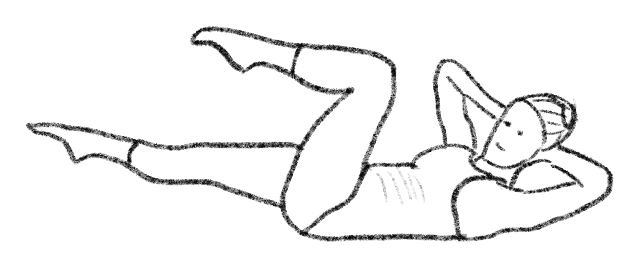
Starting position: Supine, legs lifted to tabletop (knees bent 90°). Hands interlaced behind head, elbows open. Upper body curled to chest lift, lumbar lightly pressing into mat, slight posterior tilt allowed. Breathing/Movement: Maintain curl height. Exhale, rotate upper body left, drawing left knee toward chest, extending right leg long and low (45° or higher). Right shoulder/elbow moves toward left knee, but do not touch. Inhale, control return through center (legs to tabletop, trunk center). Exhale, rotate right. Repeat alternating. May hold rotation for 2 counts to deepen challenge. Imagery: Trunk like a twisted towel, twisting from ribs; legs like scissors, opening and closing precisely; magnetic attraction between shoulder and knee, but never touching.
起始位:仰卧,双腿抬起呈桌面姿势(膝盖弯曲90度)。双手手指交叉置于头后方,手肘打开。上半身卷起到胸部抬起的位置,保持腰椎轻轻压向垫子,骨盆可微微后倾。 呼吸与动作:保持躯干卷起高度不变。吐气,同时上半身向左旋转,将左膝收向胸口,右腿向远方延伸伸直(与地面呈45度角或更高)。右侧肩膀/手肘朝向左侧膝盖靠近,但避免触碰。吸气,有控制地经过中间(双腿收回桌面,躯干回正)。吐气,转向右侧。重复交替。可在一侧旋转位停留2拍以加深挑战。 想象提示:想象躯干像被拧紧的毛巾,从肋骨开始扭转;双腿像剪刀,一收一伸精准配合;肩膀和膝盖之间像有磁力相吸,但始终保持微小距离。
IMAGERY 意象
Direct: Feel deep contraction of opposite oblique and stretch of same-side oblique. Indirect: Like a precise engine, pistons (legs) and crankshaft (trunk) working together. Space: Imagine trunk fixed in a cylinder, maintaining cylinder shape during rotation. Feeling: Focus on the drawing together of opposite shoulder and hip, and continuous abdominal support.
直接:感受对侧腹斜肌的深度收缩和同侧腹斜肌的拉伸。间接:像一台精密的引擎,活塞(腿)和曲轴(躯干)协同运转。空间:想象躯干被固定在一个圆柱体中,旋转时始终保持圆柱体的形态。感觉:注意力放在对侧肩与髋的靠近感,以及腹部持续收紧的支撑感上。
TACTILE CUES 触觉提示
1. Gently support back of head, lightly touch opposite ribs on rotation side, guide initiation of rotation. 2. Lightly place hands on pelvis, cue to stay stable, avoid rocking. 3. During leg movement, lightly touch thigh, guide independent hip motion. 4. Lightly touch medial scapulae, cue to stay depressed and stable.
1. 一手轻托练习者后脑勺,一手轻触其旋转方向的对侧肋骨,引导旋转的启动。2. 双手轻放在其骨盆两侧,提示保持稳定,避免晃动。3. 在收腿伸腿时,轻触其大腿,引导髋关节的独立运动。4. 轻触其肩胛骨内侧缘,提示保持下沉稳定。
PROGRESSION 进阶
1. Hold rotation longer (eg: 2-4 counts). 2. Increase tempo while maintaining control. 3. Lower extended leg (decrease hip flexion angle).
1. 在旋转位停留更长时间(如2-4拍)。2. 加快动作节奏,同时保持控制。3. 伸直腿时髋屈角度减小(放得更低)。
REGRESSION 退阶
1. Rotate with both knees bent, don't extend leg. 2. Reduce rotation range. 3. Place hands beside head (not behind) to reduce neck pressure. 4. Keep head on mat, perform only leg alternation and trunk rotation.
1. 保持双膝弯曲进行旋转,不伸直腿。2. 减小旋转幅度。3. 将手放在头侧方而非头后,减少颈部压力。4. 头部不抬起,枕在垫上,仅做腿的交替和躯干旋转。
COMMON ERRORS 常见错误
Excessive cervical flexion (chin to chest); scapular elevation or shrugging; elbow touching knee (loss of control); abdominal bulging (excessive intra-abdominal pressure); lumbar arching off mat; using elbows instead of trunk to rotate; trunk rising/falling during rotation.
颈椎过度屈曲(下巴压胸);肩胛骨上提或耸肩;手肘碰到膝盖(失去控制);腹部突起(腹内压过大);腰椎反弓离地;用手肘力量而非躯干带动旋转;躯干在旋转时上下起伏。
PRECAUTIONS 注意事项
Caution for cervical spine conditions, acute lumbar disc herniation; use regressions (head on mat, legs higher).
颈椎病、腰椎间盘突出急性期者慎做,或采用头枕地、腿抬高角度的降阶版本。