BENEFITS 益处
Strengthens abdominal strength and control; improves core stability dynamically; coordinates limbs with core; increases hip flexibility.
强化腹肌力量与控制;改善核心在动态下的稳定性;协调四肢与核心的配合;提高髋关节灵活性。
TARGET MUSCLES 目标肌群
Rectus abdominis (maintain curl), transversus abdominis and internal obliques (core stability), hip flexors (control leg extension), hip adductors (stabilize leg position), shoulder girdle stabilizers (maintain head/neck posture).
腹直肌(维持卷起)、腹横肌与腹内斜肌(核心稳定)、髋屈肌(控制伸腿)、髋内收肌(稳定腿位)、肩带稳定肌群(维持头颈姿势)。
SETUP 设置
None.
无特殊器械调节。
CUES 口令
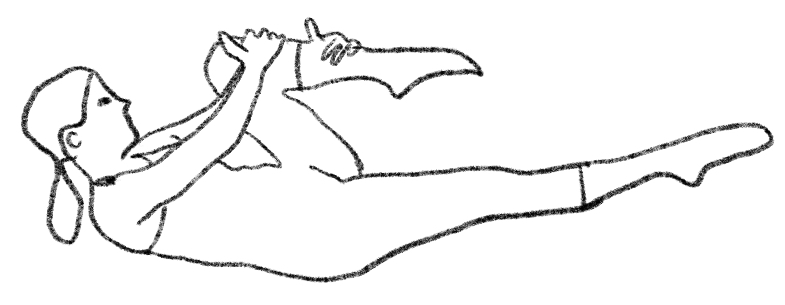
Starting position: Supine, knees bent toward chest. Right hand holds right ankle, left hand under left knee. Keep shins parallel to floor. Slight posterior pelvic tilt may help lumbar contact mat. Breathing/Movement: Inhale, curl head, neck, shoulders off mat. Exhale, continue curling, extend left leg forward and down, hovering above floor. Keep lumbar stable on mat. Use shin to resist hand pull, helping thoracic curl more. Inhale, draw left leg back in, legs together at center. Exhale, extend right leg. Alternate leg flexion/extension. Hands always on bent leg (outside hand on ankle, inside hand above knee), shins parallel to floor. Imagery: Legs like bicycle pedals, alternating circles; core like stabilizer, keeping trunk curled and steady regardless of leg movement.
起始位:仰卧,双膝弯曲拉向胸口。右手握住右脚踝,左手放在左膝盖下方。保持胫骨平行于地面。骨盆可微微后倾以帮助腰椎贴地。 呼吸与动作:吸气,从头、颈到肩膀依次卷起离地。吐气,继续上卷,同时将左腿向前下方延伸,浮于地面上方。保持腰椎稳定在垫子上。用胫骨对抗手的拉力,帮助胸椎屈曲更多。吸气,左腿收回,双腿在中间并拢。吐气,右腿延伸出去。双腿交替做屈曲与伸展。双手始终在弯曲腿的相应位置(外侧手在脚踝,内侧手在膝盖侧上方),保持胫骨平行于地面。 想象提示:想象双腿像自行车踏板,交替画圆;核心像稳定器,无论腿如何运动,身体躯干都保持卷起的高度和稳定。
IMAGERY 意象
Direct: Feel abdominals continuously engaged, trunk stable, legs alternating like a pendulum. Indirect: Like a precise train, engine (trunk) steady, wheels (legs) alternating rhythmically. Space: Imagine trunk fixed in a V-shaped groove, only legs moving. Feeling: Focus on sustained lower abdominal engagement and independent hip movement during extension.
直接:感受腹肌持续收缩以维持躯干稳定,双腿如钟摆交替。间接:像一辆精密的火车,车头(躯干)稳定,车轮(腿)规律交替。空间:想象躯干被固定在V形槽中,只有腿可以活动。感觉:注意力放在下腹部持续的收紧感和伸腿时髋关节的独立运动感上。
TACTILE CUES 触觉提示
1. Gently support back of head, lightly touch lower abdomen, cue head-hand opposition and abdominal engagement. 2. Lightly place hands on pelvis, cue to stay stable, avoid rocking. 3. During leg extension, lightly touch front of thigh, guide to reach long. 4. When switching legs, lightly touch shin, cue to keep parallel.
1. 一手轻托练习者后脑勺,一手轻触其下腹部,引导“头手对抗”和“腹收腰稳”的感觉。2. 双手轻放在其骨盆两侧,提示保持稳定,避免晃动。3. 在腿伸展时,轻触其大腿前侧,引导向远延伸。4. 轻触其交换腿时的小腿,提示保持胫骨平行。
PROGRESSION 进阶
1. Change breath pattern and counts (eg: fast switch or longer hold on one side). 2. Lower extended leg (decrease hip flexion angle) to increase core challenge. 3. Add dorsiflexion or plantarflexion on extension for variation.
1. 改变呼吸模式与次数(如快速换腿或延长单边保持)。2. 伸直的腿髋屈角度减小(放低),增加对核心的挑战。3. 伸直腿时勾脚或绷脚增加变化。
REGRESSION 退阶
1. Place one hand behind head for neck support. 2. Keep extended leg at 45° to reduce demand on abdominals and lumbar. 3. Keep extended leg slightly bent to shorten lever. 4. Reduce range, leg not as low.
1. 一手放在头后支撑,减轻颈部压力。2. 伸直的腿保持45度角,减少对腹肌和腰椎的要求。3. 伸直的腿膝盖微弯,缩短力臂。4. 减小动作幅度,腿不必伸得太低。
COMMON ERRORS 常见错误
Pulling knee forcefully to chest (causing pelvic rock); shoulder shrugging or lifting; chin jutting or excessive tightening; extended leg limp; lumbar arching off mat; anterior pelvic tilt; body swaying side to side.
将膝盖用力拉向胸口(导致骨盆晃动);耸肩或肩胛提起;下巴前突或过度收紧;伸出的腿懒散无力;腰椎反弓离地;骨盆前倾;身体左右摇晃。
PRECAUTIONS 注意事项
Caution for cervical spine conditions, acute lumbar disc herniation; use regressions (head on mat, legs higher).
颈椎病、腰椎间盘突出急性期者慎做,或采用头枕地、腿抬高角度的降阶版本。