BENEFITS 益处
Strengthens core and shoulder girdle stability; improves control of hip flexion; enhances posterior chain strength; increases proprioception in reverse plank position.
强化核心肌群及肩带稳定性;改善髋关节屈曲的控制能力;增强身体后链力量;提高在反向平板姿势下的本体感觉。
TARGET MUSCLES 目标肌群
Transversus abdominis, rectus abdominis, internal/external obliques (core stability), serratus anterior and lower trapezius (scapular stability), hip flexors (iliopsoas, rectus femoris, etc. control leg lift), hamstrings and glutes (stance leg stability), deltoids and triceps (support).
腹横肌、腹直肌、腹内斜肌、腹外斜肌(核心稳定)、前锯肌与下斜方肌(肩胛稳定)、髋屈肌(髂腰肌、股直肌等控制抬腿)、腘绳肌与臀肌(支撑腿稳定)、三角肌与肱三头肌(支撑)。
SETUP 设置
None.
无。
CUES 口令
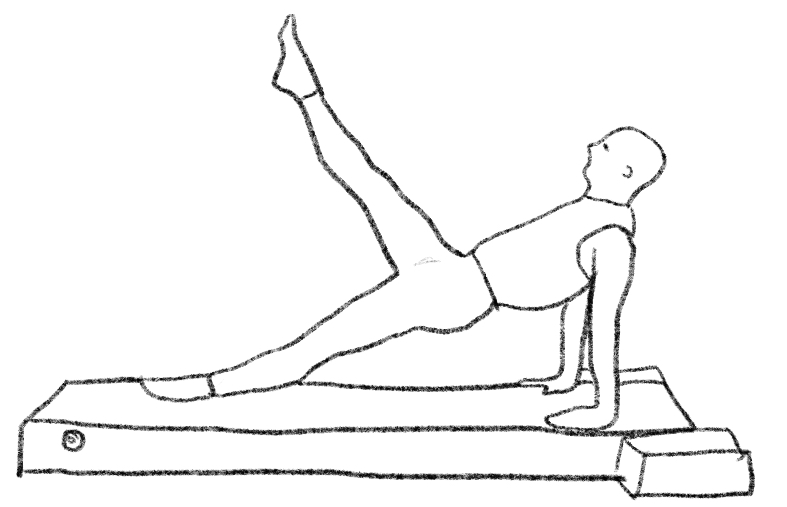
Starting position: Long sit, hands behind hips, fingers forward, shoulders and elbows straight, shoulders aligned over wrists. Legs straight together. Inhale prepare, exhale engage core, lift pelvis up until only hands and soles support trunk, body in straight line (reverse plank). Neck comfortable, not hyperextended. Breathing/Movement: Hold reverse plank. Inhale, lift one leg straight toward ceiling (hip flexion), maintaining neutral spine and pelvis. Exhale, control leg down. Repeat other side. Imagery: Body like a sturdy table, tabletop (trunk) level, legs (supporting limbs) stable; during leg lift, imagine leg pulled up by a string, tabletop still.
起始位:长坐姿势,双手放在臀部后方,手指朝前,肩膀和手肘伸直,肩与手腕对齐。双腿伸直并拢。吸气准备,吐气时收紧核心,将骨盆向上抬起,直至只有手和脚掌在地面支撑躯干,身体呈一条直线(反向平板式)。颈部保持舒适位置,不后仰。 呼吸与动作:保持反向平板姿势。吸气,一侧腿伸直,髋关节屈曲,将腿向天花板方向抬起,保持脊椎和骨盆中立稳定。吐气,有控制地将腿放下。换边练习。 想象提示:想象身体像一张坚固的桌子,桌面(躯干)水平稳固,桌腿(支撑手脚)稳定;抬腿时,想象腿像被一根线轻轻拉起,桌面纹丝不动。
IMAGERY 意象
Direct: Feel deep core continuously engaged, keeping trunk tabletop-steady. Indirect: Like a sturdy table, top still even as an object (leg) moves above it. Space: Imagine a solid rectangular frame inside trunk, unchanged by leg movement. Feeling: Focus on abdominals drawing toward spine and stability of supporting-side scapula.
直接:感受核心深处持续收紧以维持躯干如桌面般平稳。间接:像一张稳固的桌子,任凭桌面上方有物体(腿)移动,桌面本身纹丝不动。空间:想象躯干内部有一个坚固的矩形框架,无论腿如何移动,框架都保持不变形。感觉:注意力放在腹部收向脊柱的支撑感和支撑侧肩胛骨的稳定感上。
TACTILE CUES 触觉提示
1. Lightly place hands on client's pelvis, cue to stay level, avoid tilt or rotation. 2. Lightly touch lower abdomen, cue core engagement, avoid sagging. 3. During leg lift, lightly touch front of lifted thigh, cue initiation from hip, not lumbar. 4. Lightly touch supporting-side scapula, cue to stay stable and depressed.
1. 双手轻放在练习者骨盆两侧,提示保持水平,避免倾斜或旋转。2. 轻触其下腹部,提示核心收紧,避免塌腰。3. 在抬腿时,轻触其抬起腿的大腿前侧,引导其用髋部发力而非腰椎。4. 轻触其支撑侧肩胛骨,提示保持稳定下沉。
PROGRESSION 进阶
1. Repeat 3-5x on one side before switching to challenge endurance. 2. Slightly externally rotate lifted leg to increase anti-rotation demand. 3. Keep head in line with trunk (not resting on hands) to challenge neck flexors.
1. 每侧重复3-5次再换边,挑战耐力。2. 抬腿时腿微微外旋,增加对核心抗旋的要求。3. 将头与躯干保持对齐(不枕在手上),增加对颈屈肌的挑战。
REGRESSION 退阶
1. Support with knees bent to shorten lever. 2. Support on forearms to reduce wrist pressure and shoulder demand. 3. Reduce leg lift range. 4. Adjust hand position for comfort (eg: wider, forward, or back).
1. 弯曲膝盖支撑,缩短力臂。2. 前臂支撑在地面上,降低对手腕的压力和对肩带的要求。3. 减小抬腿幅度。4. 手可以放在更舒适的位置,如向外、向前或向后微调。
COMMON ERRORS 常见错误
Loss of core support causing pelvic drop or rib flaring; wrist hyperextension; pelvic drop or rotation during leg lift; anterior pelvic tilt; chest collapse.
失去核心肌肉支撑导致骨盆塌陷或肋骨外翻;手腕超伸;抬腿时骨盆塌陷或旋转;骨盆前倾;胸口塌陷。
PRECAUTIONS 注意事项
Caution or regress for wrist pain, rotator cuff injury, acute lumbar disc herniation. Avoid breath holding for hypertension.
手腕疼痛、肩袖损伤、腰椎间盘突出急性期者慎做或降阶。高血压患者避免憋气。