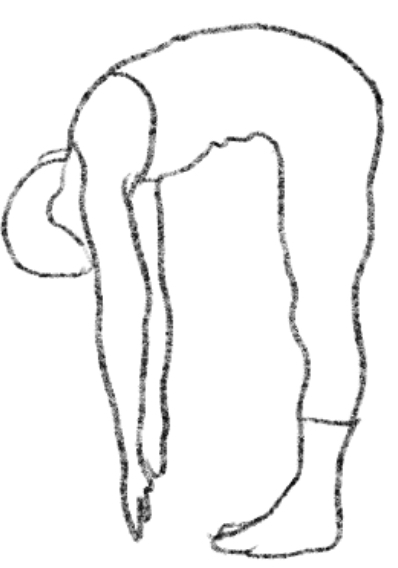
BENEFITS 益处
Improves spinal articulation in flexion; enhances eccentric control of posterior chain; increases proprioception in sagittal plane; improves posture.
改善脊椎分节屈曲的活动度;增强身体后链的离心控制能力;提高身体在矢状面上的本体感觉;改善姿态。
TARGET MUSCLES 目标肌群
Abdominals (eccentric control on roll down, concentric on roll up), erector spinae (eccentric stretch), hamstrings and glutes (support and control at bottom), gastrocnemius and soleus (maintain balance).
腹肌(离心控制卷下,向心控制卷上)、竖脊肌(离心拉伸)、腘绳肌与臀肌(在底部支撑与控制)、腓肠肌与比目鱼肌(维持平衡)。
SETUP 设置
None. May practice against wall for stability.
无。可靠墙练习以增加稳定性。
CUES 口令
Starting position: Stand, feet parallel hip-width, weight 60% on balls, 40% on heels. Spine neutral. Breathing/Movement: Inhale, lengthen trunk up. Exhale, initiate with a nod (chin slightly tucked), articulate spine down segmentally. At full flexion, let pelvis hinge over femurs (hip flexion), legs still vertical. Head and arms completely relaxed. Inhale at bottom. Exhale, initiate from pelvis, stack spine back up segmentally to standing. Imagery: Spine like a string of pearls, dropping from top, stacking from bottom; head and arms like ripe fruit, hanging heavy.
起始位:站立,双脚平行与髋同宽,重心60%在前脚掌(跖球),40%在脚跟。脊椎中立位。 呼吸与动作:吸气,躯干向上延伸。吐气,从点头动作开始(下巴微收),引导脊椎一节一节向下卷动。卷至最底端后,让骨盆绕过股骨(髋关节)继续前卷,双腿仍保持垂直于地面。头部和手臂完全放松。在底部吸气。吐气,由骨盆启动,开始从尾骨一节一节向上堆叠卷回,逐节还原至起始站立姿势。 想象提示:想象脊椎像一串珍珠,从顶端开始一颗颗垂落,再从底端一颗颗堆叠;头部和手臂像熟透的果实,自然下垂。
IMAGERY 意象
Direct: Feel spine like a string of pearls dropping and stacking. Indirect: Like a willow tree, branches (spine) gently bowing to ground, then gracefully rebounding. Space: Imagine anterior disc spaces compressing, posterior spaces opening during flexion. Feeling: Focus on segmental movement from sacrum to cervical and weight distribution on feet.
直接:感受脊椎像一串珍珠逐节垂落与堆叠。间接:像一棵柳树,枝条(脊椎)在风中轻柔地垂向地面,再优雅地回弹。空间:想象脊椎屈曲时,椎体前侧空间被压缩,后侧空间被打开。感觉:注意力放在从骶骨到颈椎的逐节运动顺序和重心在足底的分布上。
TACTILE CUES 触觉提示
1. Place one hand lightly on sacrum, one on head, guide initiation from pelvis and head respectively. 2. During roll down, lightly touch thoracic spinous processes to guide articulation. 3. Lightly place hands on pelvis, cue to return to vertical during roll up.
1. 一手轻放在练习者骶骨,一手轻触其头部,引导其从骨盆和头部分别启动卷动。2. 在卷下时,手指轻触其胸椎棘突,引导逐节运动。3. 双手轻放在其骨盆两侧,提示卷上时骨盆及时回正到垂直面。
PROGRESSION 进阶
1. At bottom, try not to bend knees to increase hamstring challenge. 2. Perform with eyes closed to enhance proprioception.
1. 在卷到底时,尝试不弯膝盖,增加对腘绳肌的挑战。2. 闭眼完成,增强本体感觉。
REGRESSION 退阶
1. Practice against wall for tactile feedback and stability. 2. If hamstrings are tight, slightly bend knees at bottom. 3. Reduce range of motion.
1. 靠墙练习,增加触觉反馈和稳定性。2. 卷到底时,如果腘绳肌过紧,可以微屈膝盖。3. 减小卷动幅度。
COMMON ERRORS 常见错误
Excessive weight shift to heels; excessive chin tuck (too much cervical flexion); premature posterior pelvic tilt; initiating roll down with pelvis too early; pelvis not returning to vertical during roll up; unclear spinal articulation; neck or shoulder tension; knee hyperextension.
重心过度移到脚跟;过度收下巴(颈椎屈曲过大);骨盆后倾发生得过早;往下卷时,骨盆动作太早发生;往上卷时,骨盆没有及时回正到垂直面;脊椎分节动作不清晰;颈部或肩膀紧张;膝盖超伸。
PRECAUTIONS 注意事项
Caution for vertigo, hypertension, glaucoma (head below heart). Avoid or reduce range for acute lumbar disc herniation. Caution for osteoporosis.
眩晕症、高血压、青光眼患者慎做(因头部低于心脏)。腰椎间盘突出急性期者避免或减小幅度。骨质疏松症者需谨慎。