BENEFITS 益处
Increases spinal mobility and abdominal strength; improves hip flexor length; teaches correct pattern of spinal articulation.
增加脊椎活动度与腹肌的力量;改善髋屈肌群长度;学习脊椎分节卷动的正确模式。
TARGET MUSCLES 目标肌群
Abdominals (primary curl), hip flexors (assist curl), hamstrings (stabilize via hand pressure), spinal extensors (eccentric control on lowering).
腹肌(主导卷起)、髋屈肌(辅助卷起)、腘绳肌(通过手压辅助稳定)、脊柱伸肌(离心控制下放)。
SETUP 设置
No special equipment needed.
无特殊器械调节。
CUES 口令
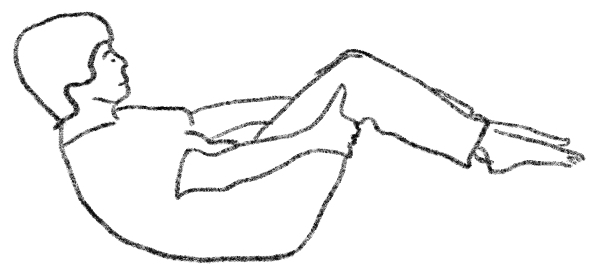
Starting position: Supine, knees bent, hands behind knees (on hamstrings). Breathing/Movement: Inhale, lengthen spine. Exhale, push legs away, simultaneously curl head, neck, spine segmentally off mat. Continue curling until sitting upright, feet staying on floor. Inhale, lengthen spine. Exhale, begin rolling back segmentally, keeping feet on floor until body weight naturally lifts them, continue rolling to supine start. Imagery: Hamstrings press hands like pressing a spring, using reaction to curl up; spine like a string of pearls, lifted and lowered by thread from tailbone.
起始位:仰卧,膝盖弯曲,双手放于膝盖后侧(大腿后侧)。 呼吸与动作:吸气,脊椎向上延伸。吐气,双腿向远处推开,同时头部、颈部、脊椎逐节卷起离开垫子。持续卷起直至坐直,双脚保持在地上。吸气,脊椎延伸。吐气,开始向后逐节回卷,保持脚在地上直到身体重量自然使其抬起,持续回卷直至回到起始仰卧位。 想象提示:想象大腿后侧用力压手,像压在一个弹簧上,借助这股反作用力将身体卷起;脊椎像一串珠子,被一根线从尾骨端逐节提起和放回。
IMAGERY 意象
Direct: Feel abdominals contract and reactive force from hamstrings pressing hands. Indirect: Like a lazy cat curling up after stretching. Space: Imagine spaces between vertebrae evenly created and compressed during roll. Feeling: Focus on stable press of hamstrings and the sequential peeling and placing of spine.
直接:感受腹肌的收缩和大腿后侧压手的反作用力。间接:像一只慵懒的猫伸懒腰后卷起身体。空间:想象脊椎在卷动时,椎体之间的空间被均匀地创造和压缩。感觉:注意力放在大腿后侧压手的稳固感,以及脊椎逐节剥离和落回垫面的顺序感上。
TACTILE CUES 触觉提示
1. Gently support back of head with one hand, press on hamstrings with other, cue coordination of hand press and head/neck lift. 2. During curl up, lightly touch lumbar spinous processes to guide articulation. 3. During roll down, lightly touch between scapulae to guide initiation from thoracic.
1. 一手轻托练习者后脑勺,一手轻压其大腿后侧,引导“手压腿、头颈起”的协同感觉。2. 在卷起时,手指轻触其腰椎棘突,引导逐节运动。3. 在卷下时,轻触其肩胛骨之间,引导从胸椎开始下落。
PROGRESSION 进阶
Perform with legs straight to increase lever and challenge.
腿伸直完成卷起与卷下动作,增加力臂和挑战。
REGRESSION 退阶
1. Use spring assistance (eg: Trapeze Table). 2. Instructor assists manually. 3. Perform only partial roll back.
1. 使用弹簧(如秋千床)辅助。2. 教练用手辅助完成。3. 只做部分后卷动作。
COMMON ERRORS 常见错误
Lack of articulation, lifting as rigid unit; using too much momentum; feet lifting too early, not naturally from hip extension; overusing rectus abdominis or hip flexors; chin jutting; shrugging; excessive scapular protraction.
脊椎没有分节活动,整体僵硬地抬起;用太多冲力/动量;脚过早抬起,而不是通过髋关节伸展自然带动腿离地;过度使用腹直肌或髋屈肌群力量;下巴前突;耸肩;过度肩胛前引。
PRECAUTIONS 注意事项
Contraindicated for acute disc conditions, acute cervical conditions, osteoporosis. During pregnancy, use assisted variation or partial roll back. For chronic disc conditions, assist as needed. For thoracic stiffness, use assisted variation or spring assistance on Trapeze Table.
急性椎间盘病症、急性颈椎病症、骨质疏松症者禁忌。怀孕期间可用辅助变化或只做部分后卷动作。慢性椎间盘病症者按需求给予辅助。胸椎僵硬者可用辅助变化或在秋千床上用弹簧辅助。