BENEFITS 益处
Improves segmental flexion and extension mobility of spine (especially thoracolumbar); enhances shoulder girdle stability and core control; promotes circulation (benefits of inversion); improves balance and proprioception in inverted position.
改善脊椎(特别是胸腰椎)的分节屈曲与伸展活动度;增强肩带稳定性与核心控制能力;促进血液循环(倒位益处);提高身体在倒置位下的平衡与本体感觉。
TARGET MUSCLES 目标肌群
Abdominals (primary for roll up), shoulder girdle stabilizers (serratus anterior, lower trapezius, etc. for support), hip flexors (control leg position), spinal extensors (eccentric control during lowering).
腹肌(主导卷起)、肩带稳定肌群(前锯肌、斜方肌下束等维持支撑)、髋屈肌(控制腿部位置)、脊柱伸肌(离心控制下放过程)。
SETUP 设置
1. Adjust barrel position: When client lies supine, inferior angles of scapulae align with bottom of barrel. 2. Ensure hands can comfortably grasp ladder rungs with arms almost straight. 3. Lock all barrel adjustments securely.
1. 调整圆桶位置:练习者仰躺时,肩胛骨下角与圆桶桶身底部对齐。2. 确保双手能舒适地抓握阶梯,且手臂近乎伸直。3. 锁紧圆桶所有固定装置。
CUES 口令
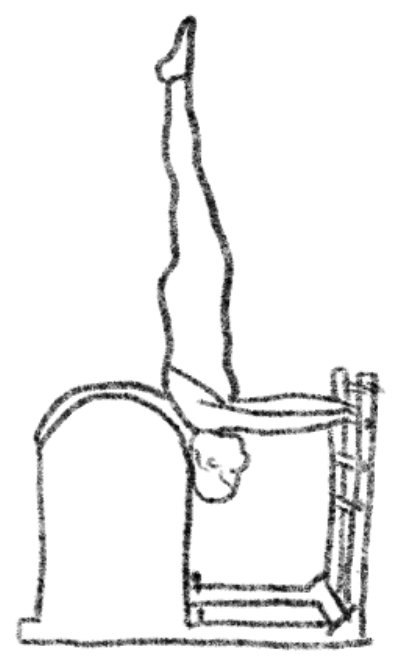
Starting position: Supine on barrel, holding ladder rungs (appropriate height), sacrum against barrel side. Legs may be straight, or knees bent with feet on box (regression). Breathing/Movement: Inhale, prepare, lengthen spine. Exhale, tighten abdominals, initiate from pelvis, lifting legs and trunk up, transitioning through hip flexion (knees may bend), until reaching shoulder stand inverted position, straighten legs if possible, feet reaching toward wall behind. Inhale, stabilize in shoulder stand. Exhale, engage core control, first depress shoulders, then guide spine from thoracic segmentally down with control until pelvis returns to barrel, finally control legs down. Use arms to push/pull on ladder for stability throughout. Imagery: Rolling up, imagine body like a carpet slowly rolling up from the tailbone; in shoulder stand, body like a stable lighthouse; rolling down, spine like a string of pearls gently placed back on ground one by one.
起始位:仰躺在圆桶上,双手抓握阶梯(高度适中),骶骨贴靠桶身侧面。双腿可伸直,或膝盖弯曲、双脚踩在箱子上(降阶)。 呼吸与动作:吸气,准备,脊椎延伸。吐气,收紧腹部,从骨盆开始带动双腿与躯干向上卷起,经屈髋(可屈膝)过渡,直至身体到达肩支撑的倒立姿势,必要时伸直双腿,脚向后方墙壁延伸。吸气,在肩倒立位稳定。吐气,启动核心控制,先将肩膀下沉,然后引导脊椎从胸椎开始一节一节有控制地向下卷动,直至骨盆落回桶身,最后双腿有控制地下降。全程利用手臂推拉阶梯来辅助稳定。 想象提示:向上卷起时,想象身体像地毯一样从尾骨端被缓缓卷起;在肩倒立位,想象身体像一座稳固的灯塔;向下时,脊椎像一串珠子被轻柔地一颗颗放回地面。
IMAGERY 意象
【Direct】Initiation: On exhale, recruit deep abdominals to lead the spine off the mat segmentally from the tailbone, shifting weight steadily between the scapulae. Axial Alignment: In Shoulder Stand, engage hip extensors to project legs vertically, ensuring ears, shoulders, and hips align. Scapular Anchor: Feel the humeral heads pressing evenly into the mat as a fulcrum to prevent cervical compression. 【Indirect】Rolling Persian Carpet: Imagine your spine as a heavy Persian carpet being rolled up, each inch of movement carrying a solid weight and refined tempo. Closing Folding Fan: View your body as a precision folding fan; the pelvis is the pivot, guiding the spine (the fan leaf) to cover backward elegantly. Deep Space Rocket: In Shoulder Stand, imagine your legs as rockets launching into deep space, while your thorax and shoulders act as the stable launch pad. 【Space】Semi-circular Transparent Bubble: As you roll over, trace and fill a massive semi-circular bubble above your head with your toes, creating a sense of three-dimensional volume. Sliding on an Invisible Pillar: Imagine your body sliding along an invisible pillar connecting ceiling to floor, sketching a perfectly upright vertical plane. Reaching Infinite Edges: Feel energy spilling from your toes to touch the infinite edges of space, maximizing your vertical lifeline. 【Feeling】Abdominal Vacuum (Kinesthetic): Imagine a powerful vacuum deep in your abdomen; use this internal suction to negate the weight of inverted legs for a silent, light roll. Peeling Tape (Tactile): Imagine each vertebra lifting off the mat like peeling strong adhesive tape, providing crisp resistance feedback for total control. Anchors in Soil (Tactile): Feel the contact points of your shoulders as anchors rooted deep in soil; this grounding sensation instantly activates back support.
【直接】启动控制:呼气时募集深层腹肌,由尾骨开始引导脊柱逐节离开垫子,将重心平稳移至肩胛骨间。中轴排列:在Shoulder Stand时通过伸髋肌群收缩,将双腿垂直投向天花板,确保耳、肩、髋垂直对线。肩带锚定:感受双侧肱骨头向垫子深处均匀按压作为支点,防止重力挤压颈椎。【间接】收起的波斯地毯:想象脊柱是一张正在收起的厚重波斯地毯,每一寸卷动都带着扎实的重量感与细腻匀速感。闭合的精密折叠扇:视身体为一个正在闭合的精密折叠扇,骨盆是活动轴心,引导脊柱(扇面)优雅稳定地向后覆盖。深空发射的火箭:在Shoulder Stand时,想象双腿是两枚向深空发射的火箭,而胸廓和肩膀是稳固的地面发射台。【空间】半圆形透明气泡:向后卷动时,尝试用足尖划过并填满头顶上方巨大的半圆形透明气泡,增加动作立体感。隐形立柱滑动:想象身体正沿着一根连接天花板与地面的隐形立柱滑动,勾勒出极致挺拔的垂直切面。触碰无限边缘:感受能量从足尖溢出,去触碰远方空间的无限边缘,在垂直维度上占据最大生命线跨度。【感觉】腹部强力吸尘器(动觉):想象腹部深处有一个向内的强力吸尘器,利用真空感抵消双腿倒置的沉重,让卷动轻盈无声。撕开胶带的拉扯感(触觉):想象每一节椎骨离开垫子时都伴随撕开强力胶带的清脆拉扯感,确保每一毫米都在掌控中。深扎土壤的锚(触觉):感受双肩与垫子的接触点如同两块深扎于土壤的锚,沉降感瞬间激活后背支撑力。
TACTILE CUES 触觉提示
1. During roll up, lightly touch client's sacrum, guiding it to roll toward ceiling. 2. In shoulder stand, lightly support both sides of hips to help with alignment and stability. 3. During lowering, lightly touch lower back (thoracolumbar junction) with fingers, cue segmental descent.
1. 在向上卷起时,一手轻触练习者骶骨,引导其向天花板方向滚动。2. 在肩倒立位,双手轻扶其髋部两侧,帮助感知对齐与稳定。3. 在下放时,手指轻触其下背部(胸腰结合处),提示逐节下落。
PROGRESSION 进阶
Once stable in shoulder stand, add leg variations like scissors, bicycle, etc., to increase challenge to core stability and coordination.
在肩倒立稳定姿势下,加入腿部动作变化,如剪刀腿、骑自行车等,增加对核心稳定和协调的挑战。
REGRESSION 退阶
1. Place box or step under feet to reduce strength and range needed for roll up. 2. Keep knees bent throughout to shorten lever. 3. Practice only rolling up halfway, or only controlled lowering from shoulder stand.
1. 在双脚下方放置箱子或踏板,减少卷起所需的力量和幅度。2. 始终保持膝盖弯曲完成整个动作,缩短杠杆。3. 仅练习卷起到一半的高度,或只练习从肩倒立位有控制地下放。
COMMON ERRORS 常见错误
Lack of effective support/protection for cervical or lumbar spine in extension; sacrum not contacting barrel firmly causing instability; over-reliance on arms or not using arms at all; excessive use of back extensors compensating for abdominals; using momentum instead of muscle control.
颈椎或腰椎在伸展位缺乏有效支撑与保护;骶骨未能贴紧圆桶导致支撑不稳;过度依赖手臂力量或完全不用手臂协助;躯干伸肌(背部)过度用力代偿腹肌工作;动作过程用惯性摆动而非肌肉控制。
PRECAUTIONS 注意事项
Avoid for hypertension, glaucoma, retinopathy; contraindicated for neck injury/discomfort, osteoporosis, acute disc herniation, severe GERD; caution with rotator cuff injuries, require assessment.
高血压、青光眼、视网膜病变患者避免;颈部受伤或不适、骨质疏松、椎间盘突出急性期、严重胃食管反流者禁忌;肩袖损伤者需谨慎评估。