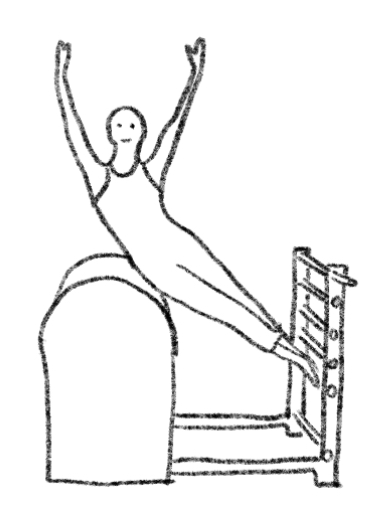
BENEFITS 益处
Improves trunk lateral flexion mobility and control; strengthens obliques and quadratus lumborum; improves rib mobility during lateral flexion.
提高躯干侧向屈曲的灵活性与控制能力;强化腹斜肌和腰方肌的力量;改善肋骨在侧屈时的活动能力。
TARGET MUSCLES 目标肌群
Internal/external obliques, quadratus lumborum (primary flexors), contralateral obliques and quadratus lumborum (eccentric control for smooth return), transversus abdominis and multifidus (deep stabilizers), shoulder girdle stabilizers (depending on arm position).
腹内斜肌、腹外斜肌、腰方肌(主导侧屈)、对侧腹斜肌与腰方肌(离心控制以平稳回正)、腹横肌与多裂肌(深层稳定)、肩带稳定肌群(根据手臂位置)。
SETUP 设置
Adjust barrel position based on client's leg length, ensuring bottom leg can straighten comfortably. Usually need to slide barrel to farthest position from ladder.
根据使用者腿长调整圆桶位置,确保下方腿能舒适伸直。通常需要将圆桶滑动到离阶梯最远的位置。
CUES 口令
Starting position: Side-lying on barrel, hip/upper thigh supported at apex. Feet may be straight or slightly bent, top foot behind. Arm options: crossed on chest, behind head, or overhead. Breathing/Movement: Inhale, prepare and lengthen spine. Exhale, engage lateral abdominals, initiate from head, side bend away from ladder, feeling top ribs open. Hold within comfortable range. Inhale prepare return. Exhale, control return to starting diagonal line, or continue slight side bend toward ladder to open lower ribs. Repeat. Can adjust breath to exhale in both directions to elicit stronger core control. Imagery: Body sliding purely sideways between two glass panels; side waist muscles like an accordion, contracting and lengthening.
起始位:侧靠在圆桶上,髋部/大腿上端支撑在圆桶顶点。双脚可伸直或微弯,上方脚放在后面。手臂位置可选择:交叉于胸前、置于头后或高举过头。 呼吸与动作:吸气,准备并延伸脊椎。吐气,启动侧腹力量,将躯干从头部引导,向远离阶梯的方向侧弯,感受上方肋骨展开。在舒适范围内保持。吸气,准备返回。吐气,有控制地将身体拉回至起始的对角直线,或继续向阶梯方向做轻微侧弯,展开下方肋骨。重复。可调整呼吸为两个方向都吐气,以诱发更强的核心控制。 想象提示:身体像被夹在两片玻璃板之间做纯粹的侧向滑动;侧腰的肌肉像手风琴一样,在收缩与拉长间转换。
IMAGERY 意象
【Direct】Muscle Recruitment: On exhale, feel the upper obliques zip up like a fastener, pulling the ribcage precisely toward the iliac crest. Alignment: Keep ears, shoulders, and pelvis in a single vertical plane throughout, avoiding any forward collapse or backward rotation. Organization: When lowering, increase the distance between the crown and the anchored foot to create maximal space between spinal segments. 【Indirect】Precision Jack: Imagine your torso as a precision jack, using the hydraulic pressure of your lateral waist to lift yourself steadily off the barrel. Paper Cutter: View your body as a large paper cutter; the pelvis is the fixed axis, and the trunk is the blade performing a precise lateral cut. Waist Winch: Imagine a resilient steel cable stretching from your ankle to your skull base, being pulled taut by a winch in your side-waist as you lift. 【Space】Filling the Fan Shape: As you lift, imagine your ribcage filling a fan-shaped void above you, tracing a full semi-circle in the air. Wall Laser Arc: Feel your crown as a laser pointer, drawing an absolutely straight vertical arc on the side wall from floor to ceiling. Narrow Vertical Shaft: Imagine moving within an extremely narrow vertical shaft; every ascent and descent must brush the side walls perfectly without swaying. 【Feeling】Peeling Soft Plastic (Texture): Feel the lift-off like peeling soft plastic from a warm mold—viscous, rhythmic, and controlled. Magnetic Pull (Resistance): Imagine the barrel surface as a giant magnet; as you lower, use your core to resist the downward attraction for an incredibly slow descent. Underarm Fountain (Buoyancy): At the peak, feel as if an upward fountain of water is cradling your armpit, making the start of the return trip light and springy.
【直接】肌肉募集:呼气向上时,感受上侧腹斜肌像拉链一样收紧,将肋骨架精准拉向髂嵴。排列要求:起落全程保持耳、肩、骨盆处于同一垂直平面,严禁胸廓前后坍塌扭转。对位组织:下降时增加头顶与锚定脚的距离,在脊柱节段间创造最大间隙。【间接】精密千斤顶:想象躯干是一台精密的千斤顶,利用侧腰的液压力平稳地将身体从桶面顶起。精准的裁纸刀:视身体为一把巨大的裁纸刀,骨盆是固定刀轴,躯干是正在进行侧向精准切割的刀刃。侧腰卷扬机:想象体内有一根从脚踝拉到颅底的钢索,向上时由侧腰的卷扬机平稳拉紧。【空间】填满扇形空间:向上提起时,想象胸廓正试图填满上方的一个扇形空间,在空中划出饱满半圆。墙面激光弧线:感受头顶是一支激光笔,在侧方墙面描绘一条从地板延伸至天花板的绝对笔直弧线。狭窄垂直坑道:想象处于极其狭窄的垂直坑道中,每一次升降都严丝合缝地贴合两侧壁,严禁前后晃动。【感觉】剥离软塑胶(质感):感受离开桶面的过程像从温热模具中剥离软塑胶,带着粘稠且有节奏的牵拉感。磁铁的吸引(阻力):想象桶面是巨大磁铁,下降时需用核心力量抗衡向下的吸引力,实现极其缓慢的降落。腋下喷泉托举(浮力/动觉):到达极点时,感受腋下仿佛被向上的喷泉水流托举,让回程启动轻盈且充满弹性。
TACTILE CUES 触觉提示
1. Lightly touch ribs on the lower side of the bend, guiding them to reach away and open. 2. Lightly touch the opposite (top) hip, cue to stay stable, prevent pelvic rotation or tilt upward. 3. During return, lightly touch the lateral abdomen, cue muscle contraction.
1. 轻触练习者侧弯方向下方的肋骨,引导其向远延伸展开。2. 轻触其对侧(上方)髋部,提示其保持稳定,防止骨盆向上旋转或倾斜。3. 在回正时,轻触其侧腹,提示肌肉收缩。
PROGRESSION 进阶
1. Perform with eyes closed to enhance proprioception and balance challenge. 2. Add slight trunk rotation at top of side bend. 3. Reach arm overhead and hold light weight (e.g., small dumbbell).
1. 闭眼进行,增强本体感觉和平衡挑战。2. 在侧弯的顶端加入轻微的躯干旋转。3. 手臂上举过头并手持轻负重(如小哑铃)。
REGRESSION 退阶
1. Place feet on floor (not suspended) to increase base of support and reduce balance difficulty. 2. Place arms by sides or on hips to reduce lever. 3. Reduce side bend range, focus on core initiation and control.
1. 双脚踩在地板上(而非悬空),以增加基底支撑和降低平衡难度。2. 手臂放在体侧或叉腰,减少杠杆。3. 减小侧屈幅度,专注于核心启动和控制。
COMMON ERRORS 常见错误
Intention to side bend but unable to effectively eccentrically lengthen; excessive cervical lateral flexion compensation; shoulder shrugging; unwanted spinal rotation during movement; spinal flexion or rounding shoulders; loss of control or cheating due to lack of abdominal strength.
有侧屈动作意图,但身体无法有效地做离心延长;颈椎过度侧屈代偿;耸肩;动作中出现不应有的脊椎旋转;出现脊椎前屈或圆肩;因缺乏腹肌力量导致动作失控或借力。
PRECAUTIONS 注意事项
Severe scoliosis requires professional assessment to avoid reinforcing imbalance; avoid or significantly modify for rib fractures or intercostal neuralgia; pregnant women need professional guidance to modify position.
严重脊柱侧弯需在专业评估下进行,避免强化不平衡;肋骨骨折或肋间神经痛者需避免或大幅调整;孕期女性需在专业指导下调整姿势。