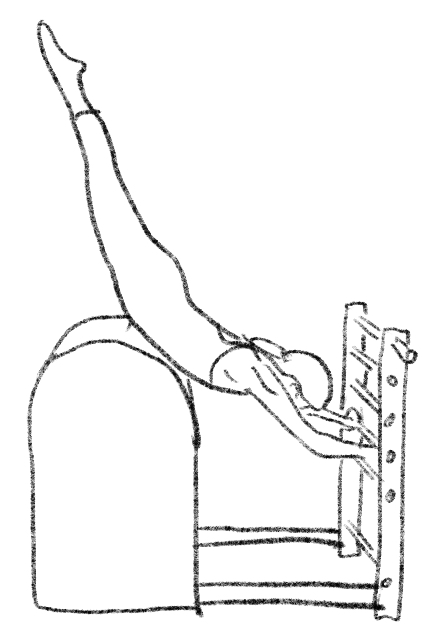
BENEFITS 益处
Strengthens spinal extensors (especially thoracic) and gluteal muscles; improves core control during dynamic flexion/extension transitions; improves shoulder girdle stability.
强化脊椎伸展肌群(特别是胸椎段)和臀部肌肉力量;提高核心在动态屈伸转换中的控制能力;改善肩带稳定性。
TARGET MUSCLES 目标肌群
Erector spinae (primary spinal extensors), gluteus maximus and hamstrings (primary hip extension and lift), abdominals (eccentric control to protect lumbar, and participate in flexion phase), shoulder girdle stabilizers (supporting body).
竖脊肌(主导脊椎伸展)、臀大肌与腘绳肌(主导髋部伸展与上抬)、腹肌(离心控制以保护腰椎,并在屈曲阶段参与)、肩带稳定肌群(支撑身体)。
SETUP 设置
Ensure ladder barrel is secure. Adjust body position so that the abdomen (navel area) is at the highest point of the barrel.
确保阶梯圆桶固定牢固。调整身体位置,使腹部(肚脐区域)位于圆桶的最高点。
CUES 口令
Starting position: Same as Swimming, prone, hands on ladder, legs straight. Breathing/Movement: Inhale, stretch long on barrel. Exhale, contract glutes and back, lift legs up and forward as much as possible, simultaneously bending knees and elbows, forming maximal C-curve from head to toe, gaze toward lowest rung. Inhale, maintaining control, straighten legs back and up into an inclined plank position. Exhale, control legs down to start, keeping knees straight, heels may gently tap 3-6 times. Variation: Keep knees bent during lift, tap with heels. Imagery: Body like a grasshopper coiling to jump, compressing energy then releasing; or like a bow, first bending to load, then extending fully.
起始位:同Swimming,俯卧,双手抓握阶梯,双腿伸直。 呼吸与动作:吸气,将身体在梯桶上充分拉伸延伸。吐气,收缩臀部和背部,将双腿尽可能向上向前抬高,同时弯曲膝盖和手肘,使身体从头到脚形成最大的C形弧度,视线看向阶梯最下级。吸气,保持控制,将双腿向后上方伸直,使身体呈一条斜线的平板姿势。吐气,有控制地将双腿下降回起始位置,过程中膝盖保持伸直,脚跟可轻轻拍打3-6下。变化式:在抬起时膝盖保持弯曲,用脚跟进行拍打。 想象提示:想象身体像一只蓄力起跳的蚱蜢,将能量压缩在弯曲的身体里然后释放;或像一张弓,先弯曲蓄力,再向后伸展拉满。
IMAGERY 意象
【Direct】Pelvic Neutral: As legs lift and criss-cross, keep the pubic bone firmly anchored to the barrel's peak to prevent lumbar compensation. Hip Alignment: Feel the femurs spiraling precisely within the acetabulum, maintaining congruency during leg beats. Thoracic Organization: Project the sternum toward the rungs on each breath, guiding the thoracic spine into an orderly extension. 【Indirect】Hummingbird Wings: Imagine your legs as the vibrating wings of a hummingbird, criss-crossing in the air with high frequency and lightness. Ship Breaking Waves: View your torso as a sturdy ship sailing through waves; no matter the turbulence from the legs behind, the hull remains steady. Precision Clockwork: Imagine your body as a precision wind-up timer, where every leg beat is a crisp tick from perfectly meshed gears. 【Space】Rear Laser Beams: Imagine your toes projecting two parallel laser beams into the void behind you, tracing infinitely extending lines in space. Lateral Parasol: During extension, feel your chest opening like a giant lateral parasol, creating a 'broad smile' between your shoulder blades. Filling the Well: Attempt to fill the 'well' between the rungs and barrel with the energy of your movement, making the body more three-dimensional. 【Feeling】Cool Breeze Under Navel (Kinesthetic): Feel as if a cool breeze is blowing beneath your navel; use this sense of lifted void to activate deep abdominals. Mental 'Click' (Auditory): Capture a rhythmic 'click' in your mind, using this auditory cue to maintain a steady and textured leg beat. Dense Silk Satin (Tactile): Imagine your legs brushing through layers of dense silk; find a fine, smooth, and resilient resistance in every cross.
【直接】骨盆中立:双腿抬起交叉时,保持耻骨稳固贴合桶顶,确保腰椎不产生过度代偿。髋部对位:感受股骨在髋臼窝内进行精准螺旋运动,保持髋关节和谐对位。胸廓组织:呼吸时将胸骨持续投向前方的梯级,引导胸椎维持有序伸展。【间接】蜂鸟振动的翅膀:想象双腿是蜂鸟振动的翅膀,以极高频率和轻盈感在空中进行微小精准的交错。破浪前行的船舰:视躯干为一艘破浪前行的坚固船舰,无论后方双腿如何波动,船身始终平稳。精密发条计时器:想象身体是一个精密发条计时器,每一次腿部击打都是齿轮间完美啮合的清脆刻度。【空间】后方虚空的激光束:想象足尖向后方虚空发射两道平行激光束,在空间中勾勒无限延伸的直线。横向撑开的遮阳伞:伸展时感受胸腔像一顶横向撑开的巨型遮阳伞,在肩胛间创造“宽阔的微笑”。填满井深空间:尝试用动作能量填满梯级与桶身间的“井”空间,使身体在三维空间中更立体。【感觉】腹下的微凉清风(动觉):感受肚脐下方仿佛有一束微凉清风吹过,利用被托举的虚空感激活深层腹肌。内心的“咔哒”声(听觉):在内心捕捉节奏明快的“咔哒”声,利用心理听觉维持腿部击打的匀速质感。致密真丝绸缎(触觉):想象双腿正在刷过层层致密的真丝绸缎,在交叉中寻找细腻、顺滑且富有韧性的阻力反馈。
TACTILE CUES 触觉提示
1. During lift, place hands lightly on sacrum and upper back, giving tactile cue to lift. 2. Lightly touch lower abdomen, cue abdominal engagement to protect lumbar, avoid compression. 3. During tapping, lightly touch heels to guide rhythm.
1. 在练习者向上抬起时,双手轻放在其骶骨和上背部,给予向上发力的触觉提示。 2. 轻触其下腹部,提示腹肌参与以保护腰椎,避免过度挤压。 3. 在拍打阶段,轻触其脚跟,引导节奏。
PROGRESSION 进阶
1. In 'plank' position, try briefly releasing hands to challenge core and shoulder girdle stability maximally. 2. Increase number or speed of taps. 3. When lifting to C-curve, try 'kicking' feet toward hands to add explosive element.
1. 在“平板”姿势时,尝试短暂松开双手,挑战核心与肩带的极限稳定。 2. 增加拍打次数或加快拍打节奏。 3. 在抬起至C形时,尝试将双脚向双手方向“蹬出”,增加爆发力元素。
REGRESSION 退阶
1. Significantly reduce lift range, focus on feeling glute and back initiation. 2. Keep hands on ladder throughout for more trunk support. 3. Omit tapping, focus on controlled lift and lower.
1. 大幅减小抬起幅度,重点感受臀部和背部的启动。 2. 双手始终抓握阶梯,为躯干提供更多支持。 3. 省略拍打动作,专注于有控制地抬起和放下。
COMMON ERRORS 常见错误
During knee bend, insufficient hip extension (glutes not engaging), compensating with excessive lumbar lordosis; neck/shoulder tension and shrugging; breath and movement uncoordinated; excessive head hyperextension in C-curve.
在膝盖弯曲时,髋关节伸展不足(臀部未充分发力),用腰椎过度前凸代偿;肩颈紧张耸肩;呼吸与动作不协调;在C形位置时头部过度后仰。
PRECAUTIONS 注意事项
Avoid for acute lumbar disc herniation, spondylolisthesis, osteoporosis; caution for rotator cuff injuries or shoulder pain; not recommended for second/third trimester pregnancy.
腰椎间盘突出急性期、脊椎滑脱、骨质疏松者应避免;肩袖损伤或肩部疼痛者慎做;怀孕中后期不建议。