BENEFITS 益处
Improves core dynamic balance and anti-extension stability in prone position; enhances dynamic control of shoulder and pelvic girdles; improves coordination between spinal extensors and limbs.
提高核心在俯卧位的动态平衡与抗伸展稳定性;增强肩胛带和骨盆带的动态控制能力;改善脊椎伸展肌群和四肢的协调工作能力。
TARGET MUSCLES 目标肌群
Core muscles (transversus abdominis, rectus abdominis, multifidus for stability and anti-extension), erector spinae (maintain slight extension), serratus anterior and lower trapezius (scapular stabilizers), glutes and hamstrings (hip extension), deltoids and arm muscles (stroking).
核心肌群(腹横肌、腹直肌、多裂肌以维持稳定并抗伸展)、竖脊肌(维持轻度伸展)、前锯肌与下斜方肌(稳定肩胛)、臀肌与腘绳肌(伸髋)、三角肌与手臂肌群(划动)。
SETUP 设置
Ensure ladder barrel is secure. Adjust body position so that the abdomen (navel area) is at the highest point of the barrel.
确保阶梯圆桶固定牢固。调整身体位置,使腹部(肚脐区域)位于圆桶的最高点。
CUES 口令
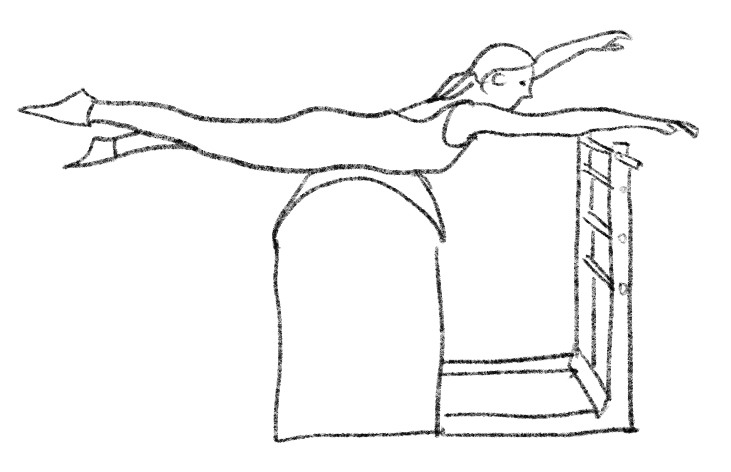
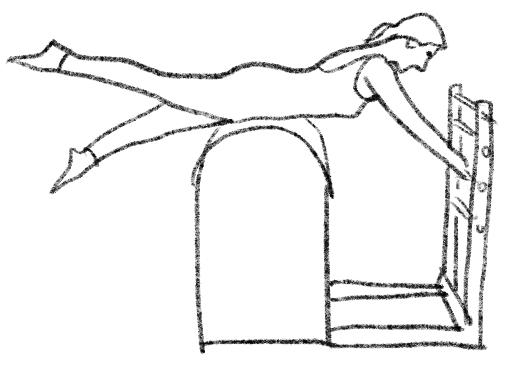
Starting position: Prone on barrel, abdomen at apex, hands grasping ladder (middle or higher rungs), legs straight, spine in natural slight extension. Breathing/Movement: Inhale, prepare and stabilize. Exhale, control release of hands, balancing on anterior pelvis and lower abdomen on barrel, lift limbs and float them. Maintain smooth breath, begin alternating contralateral arm and leg flexion/extension, simulating freestyle or similar swimming motion. Imagery: Imagine floating on water, core as stable hull, limbs as coordinated oars; body gently lengthened from crown and ankles by a string.
起始位:俯卧在圆桶上,腹部置于顶点,双手抓握阶梯(通常为中间或较高阶),双腿伸直,脊椎保持自然的轻微伸展。 呼吸与动作:吸气,准备并稳定身体。吐气,有控制地松开双手,仅以骨盆前侧和下腹部在圆桶上保持平衡,将四肢抬离并悬浮于空中。保持流畅呼吸,开始交替对侧手臂与腿的屈曲与伸展,模拟自由泳或类似游泳的动作。 想象提示:想象自己漂浮在水面上,核心是稳定的船体,四肢是协调划动的船桨;身体像被一根线从头顶和脚踝向两端轻轻拉长。
IMAGERY 意象
【Direct】Thoracic Lead: On exhale, project the sternum toward the front wall to lead thoracic extension, keeping the lower ribs in light contact with the mat. Scapular Organization: As arms lift, ensure the 'V' shape of the clavicle and scapular spine flattens outward. Extension: Create buoyancy through distal reaching of opposite limbs, keeping the pelvis firmly grounded. 【Indirect】Canyon Steel Cable: Imagine your body as a steel cable spanning a canyon; limb movements are steady vibrations while the trunk remains taut and straight. Lake Canoe: View your torso as a canoe on a calm lake; limbs are light paddles keeping the hull level and steady. Internal Fuse: Imagine a precision fuse burning from crown to toes; this continuous 'burn' drives limbs to extend infinitely. 【Space】Diagonal Corners: Reach with fingers and toes to pierce the furthest diagonal corners of the room, maximizing your lifeline. Low-Angle Searchlight: Imagine the sternum as a low-angle searchlight, sweeping light from the floor to the distant horizon. Transparent Cylinder: Imagine being inside a narrow transparent cylinder; all movements must stay strictly within the frame of your central axis. 【Feeling】Cool Airflow (Kinesthetic): Feel a cool breeze flowing under your abdomen; use this 'lifted' sensation to activate the core and decompress the spine. Pushing Through Dense Sand (Resistance): Imagine your limbs moving through dense dry sand, requiring steady, long resistance for rhythmic control. Warm Gas Airbags (Texture): Feel the intervertebral discs as a string of mini-airbags filled with warm gas, creating a floating buoyancy between vertebrae.
【直接】胸廓引导:呼气时感受胸骨平稳向前方墙壁投射,引导胸椎伸展,保持下段肋骨与垫子轻微接触。肩带组织:手臂抬起时,确保锁骨与肩胛棘构成的‘V’字形向外平铺。肢体延伸:通过对侧手脚的远端拉伸创造悬浮感,确保骨盆稳固贴合垫子。【间接】横跨峡谷的钢索:想象身体是一根横跨峡谷的钢索,四肢的拨动是匀速振动,而躯干始终紧绷且笔直。湖面航行的独木舟:视躯干为一艘平静湖面上的独木舟,四肢是轻巧划桨,保持船身水平稳定。贯穿全身的导火索:想象体内有一条从头顶燃至脚尖的精密导火索,持续的燃烧感驱动肢体无限延展。【空间】触碰对角线墙角:尝试用指尖和趾尖穿透房间对角线最远处的墙角,拉开最大的生命线。低角度探照灯:想象胸骨是一盏低角度探照灯,将灯光从地板平滑扫向前方的地平线。狭窄透明圆筒:想象处于狭窄透明圆筒中,所有动作必须严丝合缝地在身体中轴框架内进行。【感觉】腹下的微凉气流(动觉):感受腹部下方仿佛有微凉空气流过,利用被托举感激活核心,减轻腰椎压力。拨动致密干沙(阻力感):想象四肢正拨动致密干沙,需要均匀绵长的阻力反馈,确保动作节奏感。温润气体的气囊(质感):感受椎间盘像是一串注满温润气体的微型气囊,在脊椎间创造轻盈漂浮感。
TACTILE CUES 触觉提示
1. Lightly touch lower abdomen, cue core engagement to maintain balance on barrel. 2. During alternating strokes, lightly touch contralateral scapula and hip, cue coordinated movement. 3. Lightly touch heels, cue legs to reach back long.
1. 轻触练习者下腹部,提示核心收紧以维持身体在桶上的平衡。 2. 在交替划动时,轻触对侧肩胛骨和髋部,提示协调运动。 3. 轻触脚跟,提示腿向后远延伸。
PROGRESSION 进阶
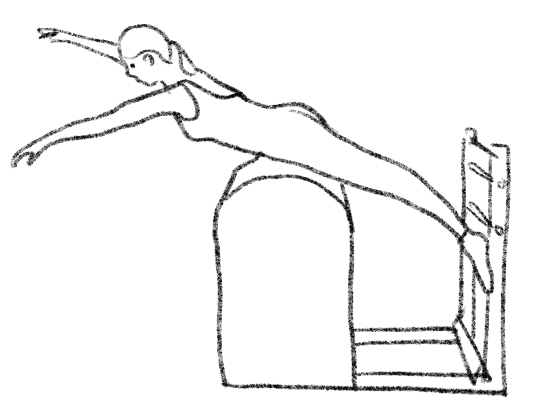
Variation: Reverse the position, feet firmly on ladder, perform 'swimming' with arms only, significantly increasing challenge to upper limbs, shoulder girdle, and core stability.
变化式:将姿势反过来,双脚稳固踩在阶梯上,仅用手臂进行“游泳”划动,大幅增加对上肢、肩带和核心稳定性的挑战。
REGRESSION 退阶
1. Keep one hand on ladder, stroke with other arm; legs may lift or stay on floor. 2. Hold ladder with both hands, perform alternating leg kicks only. 3. Place mat under barrel to prevent slipping and reduce fear.
1. 单手保持抓握阶梯,另一侧手臂进行划动,双腿可抬起或保持触地。 2. 双手抓握阶梯,仅进行双腿的交替上下踢动。 3. 在圆桶下方放置垫子以防滑落,并减少心理恐惧。
COMMON ERRORS 常见错误
Excessive scapular retraction/adduction (instead of protraction for stability); head and chest drooping; using excessive lumbar lordosis to compensate for core stability (sagging back); breath holding; moving too fast, losing control.
肩胛骨过度后缩夹紧(而非前伸稳定);头和胸部下垂;利用腰椎过度下凹来代偿核心稳定(腰部塌陷);呼吸憋气;动作过快失去控制。
PRECAUTIONS 注意事项
Caution or significantly regress for acute neck/shoulder injuries, severe lumbar injuries (e.g., acute disc herniation), severe core weakness. Caution for hypertension, vertigo with head below heart.
肩颈急性损伤、严重腰部损伤(如椎间盘突出急性期)、核心严重无力者慎做或需大幅降阶。高血压、眩晕症患者在头部低于心脏位置时需谨慎。