BENEFITS 益处
Improves extension mobility of thoracic and upper lumbar spine; enhances eccentric and concentric control of spinal extensors; strengthens core (especially abdominals) stabilization during extension; improves scapular girdle stability.
改善胸椎和上腰椎的伸展活动度;增强脊椎伸肌的离心与向心控制能力;强化核心(特别是腹肌)在伸展中的稳定与支撑功能;提高肩胛带的稳定性。
TARGET MUSCLES 目标肌群
Erector spinae (especially thoracic), multifidus (segmental control), rectus abdominis and transversus abdominis (eccentric contraction to support lumbar spine, prevent hyperextension), glutes and hamstrings (synergists to stabilize pelvis).
竖脊肌(特别是胸椎段)、多裂肌(控制分节)、腹直肌与腹横肌(离心收缩以支撑腰椎,防止过度伸展)、臀肌与腘绳肌(协同稳定骨盆)。
SETUP 设置
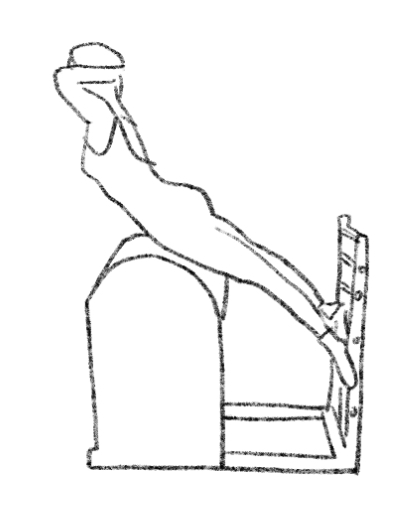
Adjust barrel so that the client's iliac crests (near ASIS) are exactly at the highest point of the barrel.
调整圆桶的位置(一般是小腿胫骨的距离),使练习者的髋骨顶端(髂前上棘附近)恰好位于圆桶的最高点。
CUES 口令
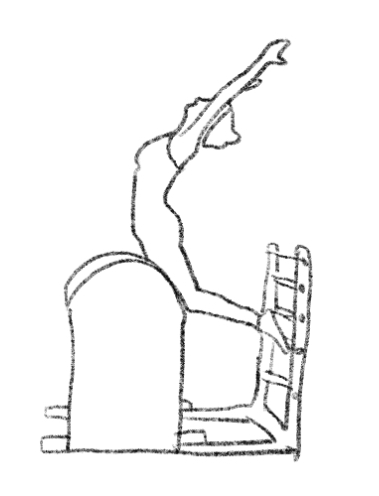
Starting position: Prone on barrel, feet firmly on ladder rungs or frame. Hands behind head, elbows open. Maintain axial elongation. Breathing/Movement: Inhale, prepare and lengthen spine; Exhale, keep abdominals drawing up and in, initiate from head, articulate spine up segmentally into extension, imagine chest sliding forward and up to comfortable angle (may slightly bend knees at top to relieve lumbar pressure). Inhale, maintain length at top; Exhale, control against gravity, articulate spine back down segmentally to start. Imagery: Body like a swan gracefully lifting neck and chest; spine like a zipper opening (lifting) and closing (lowering) from tailbone to head; abdominals like a soft corset, always supporting the waist.
起始位:俯卧在圆桶上,双脚稳固地踩在阶梯的梯子或框架上。双手放在头的后方,肘部打开。保持身体中轴延伸。 呼吸与动作:吸气,准备并延伸脊柱;吐气,保持腹肌向上向内收缩,从头部开始引导脊椎一节一节向上伸展后仰,想象胸口向前上方滑动,直至舒适的伸展角度(顶端可微屈膝以缓解腰椎压力)。吸气,在顶端保持延伸感;吐气,有控制地对抗重力,引导脊椎一节一节返回起始姿势。 想象提示:想象身体像天鹅优雅地抬起脖颈和胸膛;脊椎像拉链从尾骨到头骨一节节松开(上抬)与合上(下落);腹肌像一个柔软的束腰,始终包裹支撑着腰部。
IMAGERY 意象
【Direct】Thoracic Lead: On exhale, project your breastbone steadily toward the front wall, guiding the spine into extension. Limb Extension: On inhale, feel the legs lengthening infinitely backward as a natural continuation of the spine. Organization: Keep the scapulae sliding toward the waist, increasing space between the ears and shoulders. 【Indirect】Opening Sail: Imagine your body as a sail being slowly opened by a gentle breeze, with respiratory tension filling it from within into a perfect arc. Tensegrity Model: View your spine as a Tensegrity model, where each segment self-supports through even tension. Precision Hydraulic Pump: Imagine your breath as a hydraulic pump, where the pressure of inhalation gently lifts your spine off the barrel. 【Space】Giant Semi-circular Arc: Imagine your crown tracing a massive, room-spanning semi-circular arc deep into space. Squeezed Toothpaste Tube: Imagine your body as a toothpaste tube being squeezed from the middle, with all tissues drawing toward the midline to create maximum vertical length. Touching the Horizon: At the peak, imagine your gaze touching the distant horizon, allowing the body to occupy its widest span in space. 【Feeling】Filling Mini-Balloons (Kinesthetic): Feel the intervertebral discs as mini-balloons being slowly inflated, creating a light buoyancy between the vertebrae. Marshmallow Web (Tactile): Imagine being uniformly encased in a light marshmallow web (fascia), providing flexible support for effortless movement. Palm Garage (Tactile): Imagine the space under your palms as a tiny garage, using slight fingertip pressure to create a 'safe harbor' for the wrists.
【直接】胸廓引导:呼气时,将胸骨朝向前方墙壁平稳地投射出去,引导脊柱进入伸展。肢体延伸:吸气时,感受双腿向后方无限延长,作为脊柱长度的自然延续。对位组织:上升时保持肩胛骨向下滑向腰部,增加耳根与肩膀的空间。【间接】徐徐撑开的船帆:想象身体是一张正被微风徐徐撑开的船帆,呼吸的张力从内部均匀充盈它,形成完美弧形。张拉整体模型:视脊柱为一个张拉整体(Tensegrity)模型,各节段通过均匀张力自我支撑。精密液压泵:想象呼吸是一台精密的液压泵,吸气时产生的压力温柔地将脊柱从桶面抬起。【空间】巨型半圆弧线:想象头顶正向空间深处勾勒一个跨越整个房间的巨型半圆弧线。挤压的牙膏管:将身体想象成一支从中段被挤压的牙膏管,所有组织向中轴线收拢,创造最大垂直长度。触碰地平线:在最高点时,想象视野正触碰遥远的地平线,使身体在空间中占据最宽广的跨度。【感觉】充盈的小气球(动觉):感受椎间盘像一个个被缓慢充盈的小气球,在椎骨间创造出轻盈的浮动感。棉花糖网的包裹(触觉):想象被一层轻盈的棉花糖网(筋膜)均匀包裹,提供全方位的柔韧支撑。手掌下的避风港(触觉):想象手掌下方的空间如同一个小小的车库,通过指尖微压为手腕创造避风港。
TACTILE CUES 触觉提示
1. Lightly place hands between client's scapulae, guide upward and forward slide, avoid lumbar initiation. 2. As client lifts, lightly touch lower abdominals, cue continuous contraction to protect lumbar. 3. During lowering, lightly touch sacrum, cue to sink toward heels, aiding axial elongation.
1. 双手轻放在练习者肩胛骨之间,引导其向上向前滑动,避免腰椎发力。 2. 在练习者向上时,用手指轻触其下腹部,提示腹肌持续收缩以保护腰椎。 3. 在下落时,轻触其骶骨,提示向脚跟方向下沉,有助于中轴延伸。
PROGRESSION 进阶
1. Rotation variation: add trunk rotation at top of extension. 2. Arm variations: cross arms on chest, place by sides, or reach overhead to increase challenge to core and upper back. 3. Leg variation: straighten knees during extension to engage posterior chain.
1. 旋转变化:在伸展顶端加入躯干旋转。 2. 手臂变化:双手交叉于胸前、放于身体两侧或举高过头,以增加对核心和上背部的挑战。 3. 腿部变化:在伸展时伸直膝盖,强化后侧链整体参与。
REGRESSION 退阶
1. Reduce spinal extension range, move only within pain-free range. 2. Cross hands on chest or place by cheeks to reduce neck load. 3. Place feet on lower or wider rungs to increase base of support.
1. 减小脊椎伸展的幅度,仅在无痛范围内活动。 2. 将双手交叉放在胸前或脸颊两侧,减少头颈负荷。 3. 将双脚踩在更低或更宽的阶梯位置上,以增加基底支撑。
COMMON ERRORS 常见错误
Excessive cervical or lumbar extension (compression),or forward bending flexion; loss of abdominal support, causing rib flaring or lumbar sagging; loss of axial elongation during movement, becoming a 'broken' back; shoulder shrugging or elbows pinching together.
颈椎或腰椎过度伸展(挤压),或前弯屈曲;腹肌失去支撑,导致肋骨外翻或腰部塌陷;动作过程中失去中轴延长感,变成折腰;耸肩或肘部向中间夹紧。
PRECAUTIONS 注意事项
Avoid or significantly modify for spinal stenosis, spondylolisthesis, second/third trimester pregnancy.
椎管狭窄、脊柱滑脱、怀孕中后期者应避免或大幅调整。