BENEFITS 益处
Improves spinal extension mobility; improves abdominal fascia length; improves hip mobility; uses gravity to assist spinal articulation; improves deep muscle recruitment.
改善脊椎伸展后仰的活动度;改善腹部筋膜长度;改善髋部的活动度;让地心引力协助身体的分节动作;改善深层肌肉募集能力。
TARGET MUSCLES 目标肌群
Hamstrings (agonist), gluteus maximus (synergist), rectus abdominis (eccentric control), spinal extensors (isometric control).
腘绳肌(主动)、臀大肌(协同)、腹直肌(离心控制)、脊柱伸肌群(等长控制)。
SETUP 设置
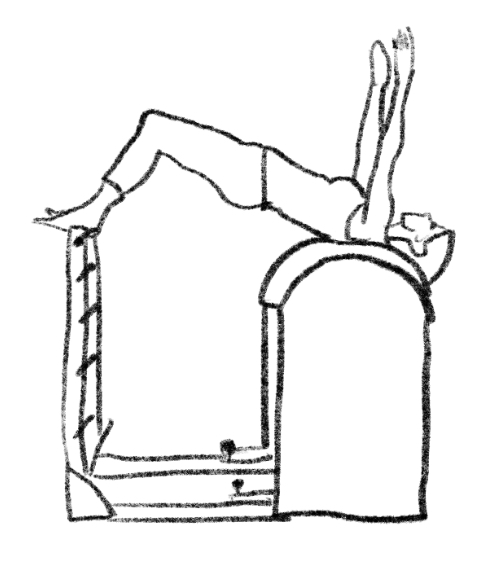
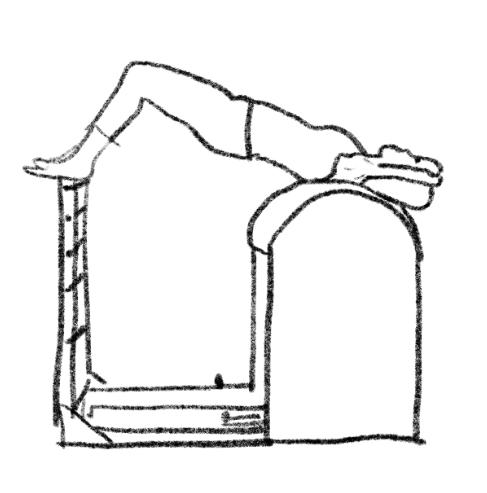
1. Secure ladder barrel bolts. 2. Adjust barrel away from ladder. 3. Adjust starting position based on client's height and flexibility, ensuring scapulae rest on barrel's highest point and body does not slide back during movement.
1. 固定好阶梯圆桶的螺栓。 2. 调整圆桶,使其远离阶梯。 3. 根据练习者身高和柔韧性,调整身体起始位置,确保肩胛骨能靠在圆桶最高点,且身体不会在动作中向后滑动。
CUES 口令
Starting position: Supine on barrel, knees bent, feet flat on ladder. Scapulae on barrel's highest point, hands behind head or crossed on chest, head may rest on barrel. Maintain axial elongation. Breathing: Inhale prepare; Exhale, use hamstrings to draw pelvis, articulating spine into flexion from thoracic, lengthening front of body. Inhale, press feet down, extend knees away for stability. Exhale, articulate spine back into extension from upper thoracic, returning to start. Imagery: Pelvis pulled toward heels by a rope; spine like pearls gently lowered and lifted by gravity; body undulates like a wave on the barrel.
起始位:仰躺在圆桶上,膝盖弯曲,双脚平放在阶梯上。肩胛骨靠在圆桶最高点,双手置于头部后方或交叉于胸前,允许时头部可轻靠在圆桶上。保持中轴延伸。 呼吸:吸气,准备;吐气,用腘绳肌力量拉动骨盆,使脊椎从胸椎开始一节节向前屈曲(卷下),身体前侧延长延伸。吸气,双脚向下压,膝盖向远处延伸,提供稳定。吐气,从上胸椎开始一节节向后伸展,回到起始姿势。 想象提示:想象骨盆像被绳子拉向脚跟;脊椎像一串珍珠被地心引力轻柔地一节节放低与提起;身体在圆桶上如波浪般起伏。
IMAGERY 意象
【Direct】Action Core: On exhale, slowly sink the pelvis into the 'well' between the rungs and the barrel, feeling uniform lumbar flexion in a non-weight-bearing state. Alignment: Ground your feet firmly on a high rung, using downward reaction force to guide the pelvis up segmentally from the bottom. Collaboration: At the peak, feel a deep stretch through the front of the thighs (quadriceps). 【Indirect】Printed Scroll: Imagine your spine as a beautiful scroll being printed, laying down millimeter by millimeter along the barrel's curved edge. Ice Cream Scoop: Imagine your pelvis as a large ice cream scoop, carving out a ball of energy from the bottom of the well and sweeping the spine upward in a graceful arc. Bridge Cables: View your legs as solid cables supporting a bridge, smoothly hoisting the bridge deck (your torso) out of the deep valley. 【Space】Exploring Negative Space: Feel your lower back exploring the negative space inside the barrel, increasing the vertical depth between your spine and the floor to create joint space. Knee Beams: Imagine your knees projecting beams of light along the line of the rungs toward the horizon, while your crown anchors in the opposite direction. Filling the Well: As the pelvis sinks, imagine your breath filling every corner of the well, making the body feel three-dimensionally expansive. 【Feeling】Heated Metal Wire (Texture): Feel your spine as a piece of heated, softened metal wire, conforming pliably to the barrel's hard edge without any rigid angles. Deep Water Gravity (Kinesthetic): As the pelvis sinks into the hollow, feel a gravitational osmosis like diving to the bottom of deep water, establishing a dynamic floating balance. Taut Rubber Band (Tension): Imagine a taut rubber band inside your body; rolling up is the process of feeling that band store and steadily release its elasticity.
【直接】动作核心:呼气时,将骨盆缓慢沉降入梯级与桶体之间的‘井’(Well)深处,感受腰椎在无负重状态下的均匀屈曲。排列要求:双脚稳固踩在梯级高处,通过足底向下的反作用力引导骨盆从底层逐节向上卷动。组织协作:在向上卷起的最高点,感受大腿前侧(股四头肌)的充分拉伸。【间接】打印出的精美画卷:想象你的脊柱是一张正在打印出来的精美画卷,顺着桶面的圆弧边缘一毫米一毫米地平铺开来。冰淇淋勺:想象你的骨盆是一个巨大的冰淇淋勺,正从桶底深处挖出一球饱满的能量,顺势带着脊椎向上划出优美的弧线。大桥缆绳:将双腿视作支撑大桥的坚固缆绳,通过缆绳的拉力将桥面(躯干)平稳地从深谷中提拉起来。【空间】探索负空间:感受下背部正探索梯桶内部的负空间,尝试增加脊柱后侧与桶底之间的垂直深度,创造最大关节间隙。膝盖发射光束:想象膝盖正沿着梯级的延长线向远方发射光束,而头顶向相反方向锚定,在空间中拉开极致长度。填满底部角落:在骨盆下沉时,想象呼吸正在填满梯桶底部的每一个角落,使身体变得更加立体饱满。【感觉】加热软化的金属丝(质感):感受脊柱像被加热软化的金属丝,极其柔顺地贴合桶面,失去任何僵硬棱角。深水底部的重力(动觉):在骨盆沉入凹陷处时,感受那种潜入深水底部的重力渗透感,建立动态悬浮平衡。拉满的橡皮筋(张力):想象身体内部有一根正在拉满的橡皮筋,向上卷起的过程就是感受橡皮筋积蓄并平稳释放弹性的过程。
TACTILE CUES 触觉提示
1. Lightly place hand on front of pelvis (near ASIS), guide toward heels. 2. During roll down, lightly touch thoracic spinous processes to cue segmental movement. 3. Lightly touch scapulae at barrel's highest point, remind to maintain stable support, avoid sliding.
1. 手轻放在练习者骨盆前侧(髂前上棘附近),引导其向脚跟方向移动。 2. 在练习者卷下时,用手指轻触其胸椎棘突,提示逐节移动。 3. 在圆桶最高点轻触其肩胛骨,提醒保持稳定支撑,避免滑动。
PROGRESSION 进阶
Single-leg bridge: lift one leg straight, perform articulation with single leg, increasing core stability and control demands.
单腿桥式:抬起一条腿并保持伸直,用单腿完成卷动与伸展,增加对核心稳定和支撑腿控制的要求。
REGRESSION 退阶
Limited range: reduce flexion and extension range, move only within pain-free controlled range; use pillow/towel for head/neck support.
活动范围受限式:减少脊椎屈曲和伸展的幅度,只在无痛且可控的范围内进行;或使用枕头/毛巾充分支撑头部和颈部。
COMMON ERRORS 常见错误
Excessive flexion/extension in any spinal segment or pelvis; rib flaring; overcompensation by abdominals, glutes, or hip flexors; head jutting forward; moving as a whole like a seesaw instead of segmentally; sliding on barrel.
脊椎任何部位或骨盆过度屈曲或后仰;肋骨外翻;腹肌、臀肌或髋屈肌群过度用力代偿;头部前伸;身体像跷跷板一样整体运动而非分节运动;在圆桶上滑动。
PRECAUTIONS 注意事项
Caution with spinal stenosis, spinal stiffness (kyphosis), post-hip replacement; for osteoporosis, modify (move as one unit hinging at hips, avoid spinal flexion); for shoulder pain, place hands on chest, elbows toward ceiling, add pillow behind head.
脊椎狭窄、脊椎僵硬(驼背)、髋关节置换术后需谨慎;骨质疏松者应调整(以髋部为枢纽直上直下,不做脊椎屈曲);肩膀痛者可将双手置于胸前,手肘指向天花板,并在头后加枕头支撑。